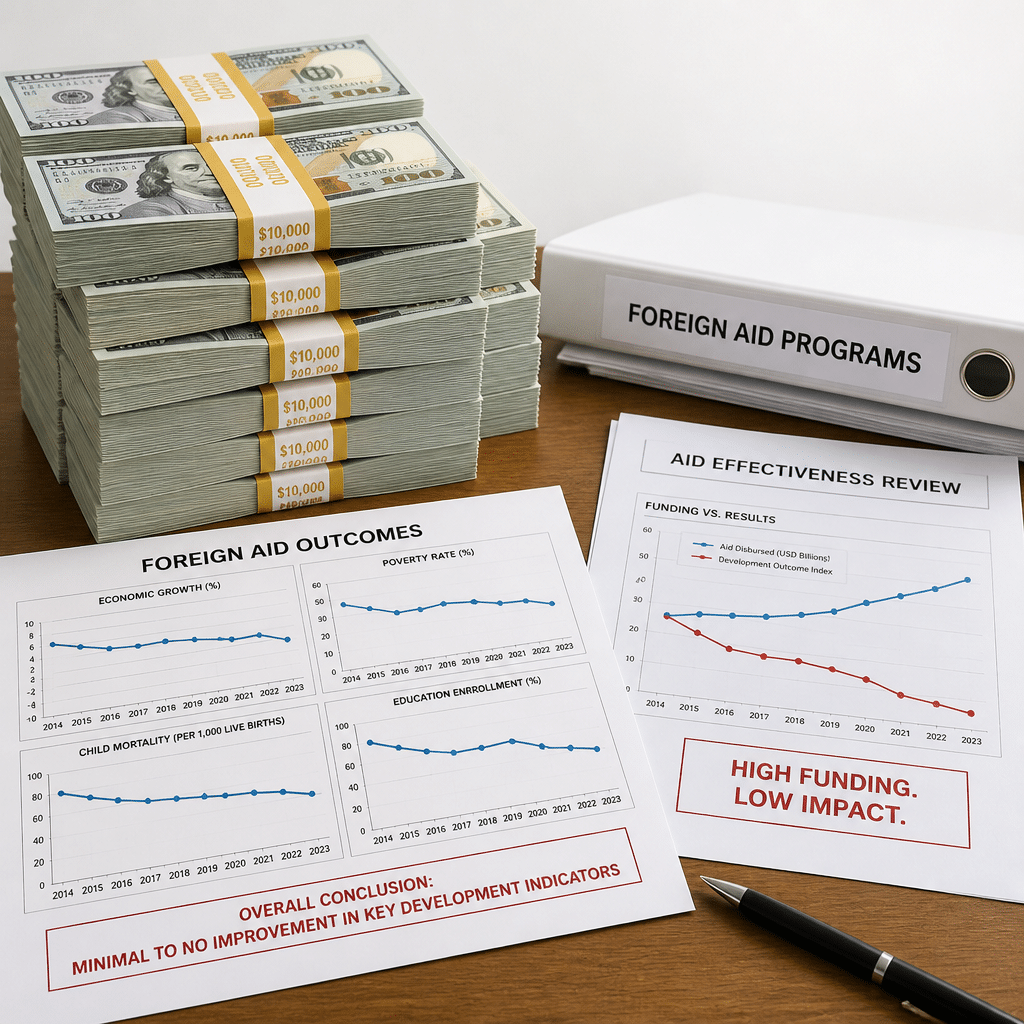
More than US$20 billion in aid has flowed into Haiti over the past six decades. By almost every measurable indicator, poverty, food insecurity, and institutional fragility have persisted. That is not a funding shortfall. That is a structural failure of the foreign aid model itself. Haiti foreign aid criticism is not a fringe position held by contrarians. It is the documented conclusion of development economists, policy analysts, and the communities that have lived through decades of well-funded but ultimately hollow interventions. Understanding why donor money alone has never been enough is the first step toward funding something that actually works.
| Key Insight | Explanation |
|---|---|
| Decades of aid have not eliminated Haitian poverty | Despite receiving over US$20 billion in development and reconstruction aid over 60 years, Haiti remains one of the most fragile states in the world, with some of the lowest development indicators globally. |
| The “humanitarian trap” keeps communities dependent | Haiti has consistently received more humanitarian aid than development-oriented aid compared to peer countries, creating a cycle of emergency response that never transitions into self-sufficiency. |
| Most aid money bypasses Haitian communities entirely | After the 2010 earthquake, the Haitian government received less than 1% of emergency relief funds. Most money flowed to foreign NGOs with little local accountability. |
| NGO proliferation has weakened Haitian institutions | With NGOs providing an estimated 80% of public services, a parallel governance structure has developed that reduces the state’s capacity to serve its own citizens over time. |
| Community ownership is the missing variable | The strongest development outcomes in Haiti come from initiatives where communities plan, implement, and maintain their own solutions, rather than receiving externally designed programs. |
| Effective giving means funding local capacity, not just services | Donors who want lasting impact should look for organizations that work with Haitian communities as active partners, not passive recipients of foreign expertise and resources. |
| Aid without coordination multiplies waste | Insufficient coordination among international stakeholders, combined with unclear development objectives, means resources are duplicated or misdirected even when the intent is genuine. |
Haiti has received more than US$20 billion in aid for reconstruction and development over the past 60 years. That figure is not in dispute. What is in dispute is why it has produced so little durable change. The country’s development indicators remain among the lowest in the world. The population remains deeply vulnerable to shocks, whether seismic, political, or economic. And the conversation about what went wrong has barely begun to reach mainstream donor audiences.
The 2010 earthquake made the failure visible in ways that were impossible to ignore. The earthquake killed more than 200,000 people and left more than 1.5 million without homes. International donors responded with historic generosity. One major international relief organization raised nearly half a billion dollars specifically to build permanent housing for displaced Haitians. By 2015, investigators were able to verify the existence of exactly six permanent structures built with those funds.
That single data point, six homes for nearly half a billion dollars, is not an outlier. It is a symptom of a system that rewards fundraising, generates reports, and produces press releases without a reliable mechanism for holding anyone accountable to the people the money was supposed to help.
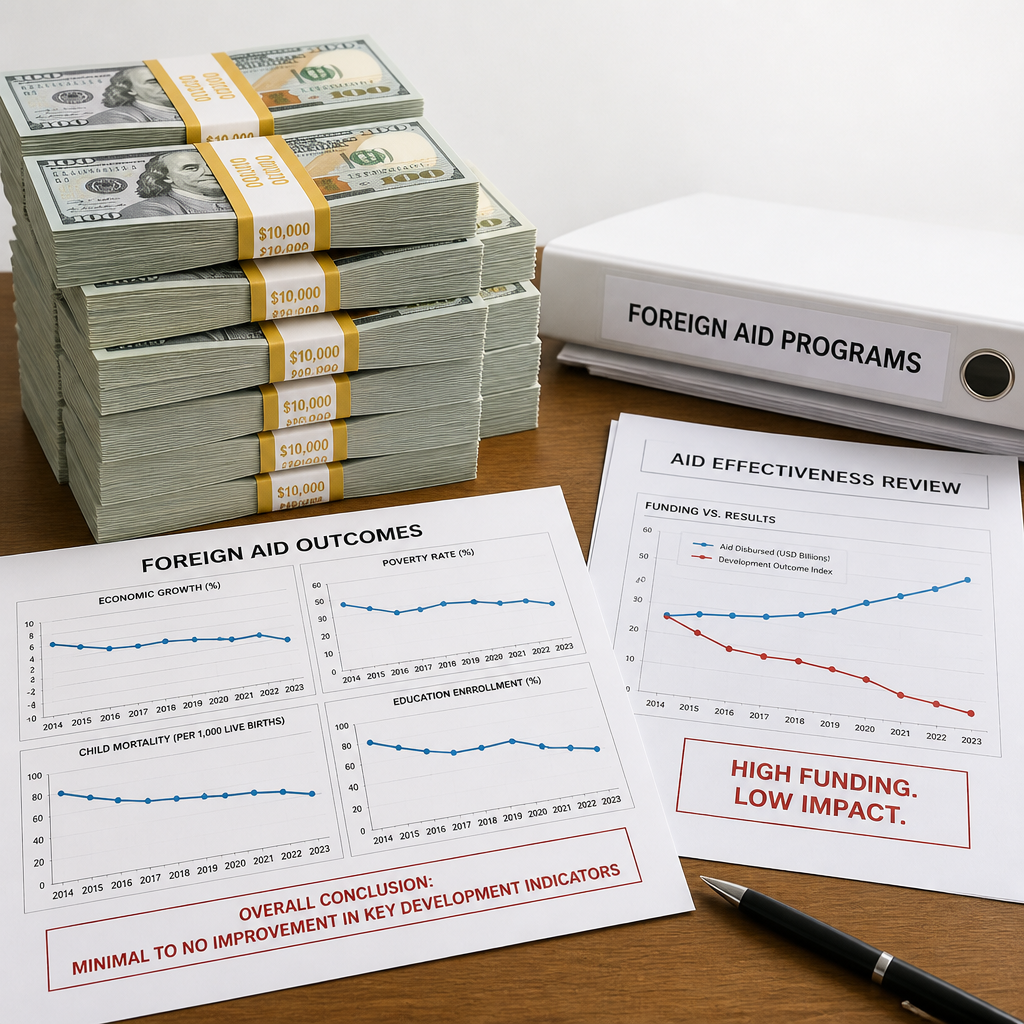

The problem is not that donors are indifferent. Most are not. The problem is that the dominant foreign aid model was not designed to produce self-sufficient communities. It was designed to produce relief. And relief, by its nature, is temporary. When the same model is applied decade after decade with development goals in mind, the result is not development. It is managed dependency.
Pro tip: When evaluating where to direct your charitable giving for Haiti, ask not what a program delivers but what it builds. A water system installed by an outside team is not the same as a gravity-fed water system designed, built, and maintained by the community it serves. The former creates a dependency on outside maintenance; the latter creates a local asset with local stewards.
Researchers studying Haiti’s aid history have identified a pattern they call the “humanitarian trap.” Compared to other low-income countries, Haiti has consistently received a disproportionate share of its international assistance in the form of humanitarian relief rather than development-oriented investment. The cumulative effect is a country permanently positioned in crisis response mode, never quite graduating to the kind of long-term capacity-building that turns aid into obsolescence.
The mechanics of this trap are straightforward. A disaster or political crisis generates international attention and donor urgency. Funds flow quickly into relief operations: food distribution, temporary shelter, emergency medical care. These are genuinely necessary in an acute phase. The problem begins when the acute phase ends but the funding architecture does not change. Organizations that are effective at emergency response are not necessarily effective at the slow, relationship-intensive work of community development. But they are already on the ground, already funded, and already claiming the territory.
Analysts have also noted that even the scale of individual aid packages to Haiti has been too small relative to the stated ambitions of donors. There is a gap between what organizations claim they will accomplish with a given budget and what can realistically be achieved, particularly when coordination between stakeholders is poor. Insufficient coordination among international actors means that resources are duplicated in some areas while genuine needs go unaddressed in others. No single organization has complete visibility into what others are doing, so the combined effect of many well-intentioned interventions is frequently less than the sum of its parts.
The absence of clearly stated, measurable economic objectives compounds this problem. When aid programs cannot be evaluated against specific outcomes, it is very difficult to determine what is working and what is not, and the incentive to continue familiar patterns, even failing ones, remains strong.
The challenge for any donor who wants to do real good in Haiti is to move past the urgency of crisis and invest in the kind of slower, community-anchored work that does not make for dramatic fundraising campaigns but does produce lasting results.
Haiti has been called, by its own citizens, “the republic of NGOs.” Before the 2010 earthquake, there were already nearly 10,000 NGOs operating in the country. The earthquake accelerated this proliferation. The Haitian government received less than 1% of emergency relief aid in the aftermath. Only 23% of long-term recovery funds went through domestic channels. The vast majority was routed directly to foreign NGOs, bypassing Haitian institutions entirely.
The consequence has been the construction of a parallel governance structure. With NGOs now providing an estimated 80% of public services in Haiti, including significant portions of education and healthcare, the state has been systematically excluded from building the administrative capacity it needs to function. Foreign organizations lacking deep cultural accountability and long-term local commitment have made decisions that should belong to Haitian communities and their elected representatives.
This is not primarily a story about malicious intent. Most people working in these organizations genuinely want to help. The structural problem is that NGOs derive their legitimacy from their ability to raise funds from outside the country, not from any social contract with the people they serve. When accountability flows upward to donors rather than outward to communities, program design optimizes for donor preferences, not community needs. Reports look good. Outcomes drift.
By circumventing local institutions and local contractors, even well-resourced aid programs have missed the opportunity to strengthen the Haitian economy and build lasting governance capacity. The money spent does not circulate locally. The skills transferred do not remain. When the program ends, so does its impact.
Pro tip: A useful question to ask any organization working in Haiti is: who has decision-making authority in your programs? If the answer is a headquarters team outside Haiti, that is a meaningful indicator of how local the impact will actually be. Organizations that place genuine decision-making power with partner communities behave differently, and produce different results, than those that consult communities but retain control.

Community-led development is not the same as community-consulted development. The distinction matters enormously in practice. Many aid programs include community meetings, needs assessments, and local input as part of their design process. But if the fundamental architecture of the program, the goals, the timeline, the budget, the exit strategy, is designed externally, the community is not leading. It is consenting, or not, to someone else’s plan.
Genuine community-led development starts from a different premise: that Haitian communities contain the expertise, the leadership, and the will to identify and address their own development needs, given the right resources and partnerships. Engineers, teachers, skilled tradespeople, healthcare workers, and community organizers already exist within Haitian communities. They are frequently unseen or underutilized by foreign-designed programs that import outside experts instead.
The measure of a successful community-led development program is not how many services it has delivered. It is whether a community has the capacity to secure its basic needs, water, food, shelter, sanitation, health, without ongoing foreign intervention. This is a fundamentally different success metric than the one most aid organizations use, and it requires a fundamentally different approach.
Organizations working within this framework, like Community2Community (C2C), structure their programs around the C2C Collaborative Framework precisely because development work done with communities produces different outcomes than development work done for communities. The goal is not to maximize the number of programs running in Haiti at any given time. It is to make those programs unnecessary by building communities that can sustain themselves.
Haiti’s strongest development solutions have consistently come from Haitians themselves. Donor support accelerates community-led development by providing the resources communities need, but it should function as a catalyst, not as the engine. The moment a community’s capacity is more important than a donor’s presence is the moment real development has started.
Not all development work is the same, and donors deserve a clear-eyed view of how different approaches actually differ in practice. The table below compares the traditional foreign aid model, the NGO service delivery model, and the community-led development model across the dimensions that matter most for lasting impact in Haiti.
| Dimension | Traditional Foreign Aid / NGO Service Delivery | Community-Led Development (C2C Collaborative Framework) |
|---|---|---|
| Decision-making authority | Rests with foreign funders, headquarters, or international NGO staff | Rests with partner communities and local leadership |
| Accountability direction | Upward to donors; communities are beneficiaries, not stakeholders | Outward to communities; donors fund outcomes communities define |
| Local economic impact | Limited; contracts and expertise often imported | Strong; local engineers, tradespeople, and educators are central |
| Sustainability after program ends | Low; dependency on continued external support is common | High; communities own and maintain what they build |
| Institutional capacity building | Minimal; parallel structures replace rather than strengthen local institutions | Central; the program’s success is measured by what it leaves behind |
| Success metric | Services delivered, budgets spent, reports filed | Community self-sufficiency; reduced reliance on foreign aid over time |
Effective giving in Haiti does not mean giving less. It means giving differently. The donors who produce the most lasting impact are those who shift their question from “how much can I give?” to “what does my giving build?” That reframing changes everything about which organizations they support and why.
A donor funding traditional relief is purchasing a service. A donor funding community-led development is investing in capacity. The difference is the same as the difference between paying someone’s rent and helping them build a house they own. Both involve money. Only one produces a durable asset.
For donors who want their giving to produce lasting change in Haiti, a few concrete questions are more useful than any marketing brochure:
First, does the organization work with communities as genuine partners, or does it design programs in offices far from the communities those programs affect? Second, are Haitian professionals, local engineers, educators, tradespeople, and health workers, central to program delivery, or are they support staff for externally led teams? Third, what happens when the funding ends? Does the community have assets, skills, and governance structures it owns and controls, or does the program simply stop?
C2C’s approach to these questions is embedded in its Collaborative Framework. Partner communities are involved from the earliest stage of need identification through implementation and long-term maintenance. The goal is for every project, whether it addresses water access, sanitation, education, or economic development, to leave behind a community more capable than it was before the intervention, not a community waiting for the next round of funding.
One structural feature of effective community development funding is consistency over time. Community-led development is not a sprint. It requires sustained investment across multiple years as communities build capacity, implement infrastructure, and establish the governance practices needed for long-term self-management. Monthly giving programs that commit donors to multi-year support are significantly more useful for this kind of work than single emergency donations, which tend to fund the acute phase without touching the development phase at all.
This is not a criticism of donors who give in response to crises. Those moments of generosity are real and often necessary. The gap is in what happens next. The donors who change Haiti’s trajectory over time are those who stay engaged after the cameras leave, funding the slower and less dramatic work of building communities that can stand on their own.
Yes, and it is important to say so clearly. Emergency aid has saved lives in acute crises, including after the 2010 earthquake and subsequent disasters. Vaccination campaigns, food distribution in famine conditions, and emergency medical care have measurable positive effects. The critique of Haiti foreign aid is not that aid has done nothing. It is that decades of humanitarian-focused assistance have not catalyzed the structural development that eliminates the need for that assistance. The humanitarian gains are real; the development gains are not commensurate with the investment.
The core structural issue is accountability. NGOs raise funds from donors outside Haiti, so their organizational incentives push them to optimize for donor satisfaction rather than community outcomes. Programs that make good fundraising stories are not always programs that build lasting community capacity. Additionally, organizations designed for emergency response are often not well-suited for the slower, relationship-intensive work of development. When the same institutions are expected to perform both functions, neither tends to be done well.
In practice, it changes who makes decisions and who owns the results. In a community-led model, the community identifies its most pressing needs, participates in designing solutions, and retains ownership of the infrastructure or programs that result. Local engineers and skilled workers are employed rather than imported. Maintenance plans are developed by people who will actually carry them out. The result is that when a program ends, something durable remains. A water system maintained by the community that built it has a very different lifespan than one installed by an outside team that has since left.
No. Individual donors giving at any level can contribute to effective, community-led development in Haiti. The key is directing those resources toward organizations that use the community-led model rather than the traditional service delivery model. Monthly giving programs are particularly well-suited for individual donors because they provide the consistent, multi-year funding that community development requires, without needing to write a single large check. The most important factor is not the size of the donation but where it goes and how the organization uses it.
The evidence does not support a complete withdrawal of international support; it supports a fundamental change in how that support is structured. Haitian communities have genuine resource constraints that external funding can help address. What they do not need is external decision-making replacing local leadership. The effective model is one where international donors provide resources and, where genuinely useful, technical knowledge, while communities retain authority over how those resources are used and what they are used to build. Reducing reliance on foreign aid is the goal, not reducing the dignity of communities that currently have unmet needs.
Look past mission statements and look at program design. Ask who makes budget decisions, who leads implementation, and what governance structures communities retain after a program closes. Ask whether Haitian professionals are central to program delivery or peripheral to it. Ask what the organization’s explicit theory of change is and whether it includes measurable indicators of growing community self-sufficiency over time. Organizations genuinely committed to community-led development can answer these questions with specificity. Those that cannot usually are not operating that way, regardless of the language on their website.
If you have seen how foreign aid has played out in Haiti firsthand, as a community member, a donor, or a practitioner, we would value your perspective in the comments below.