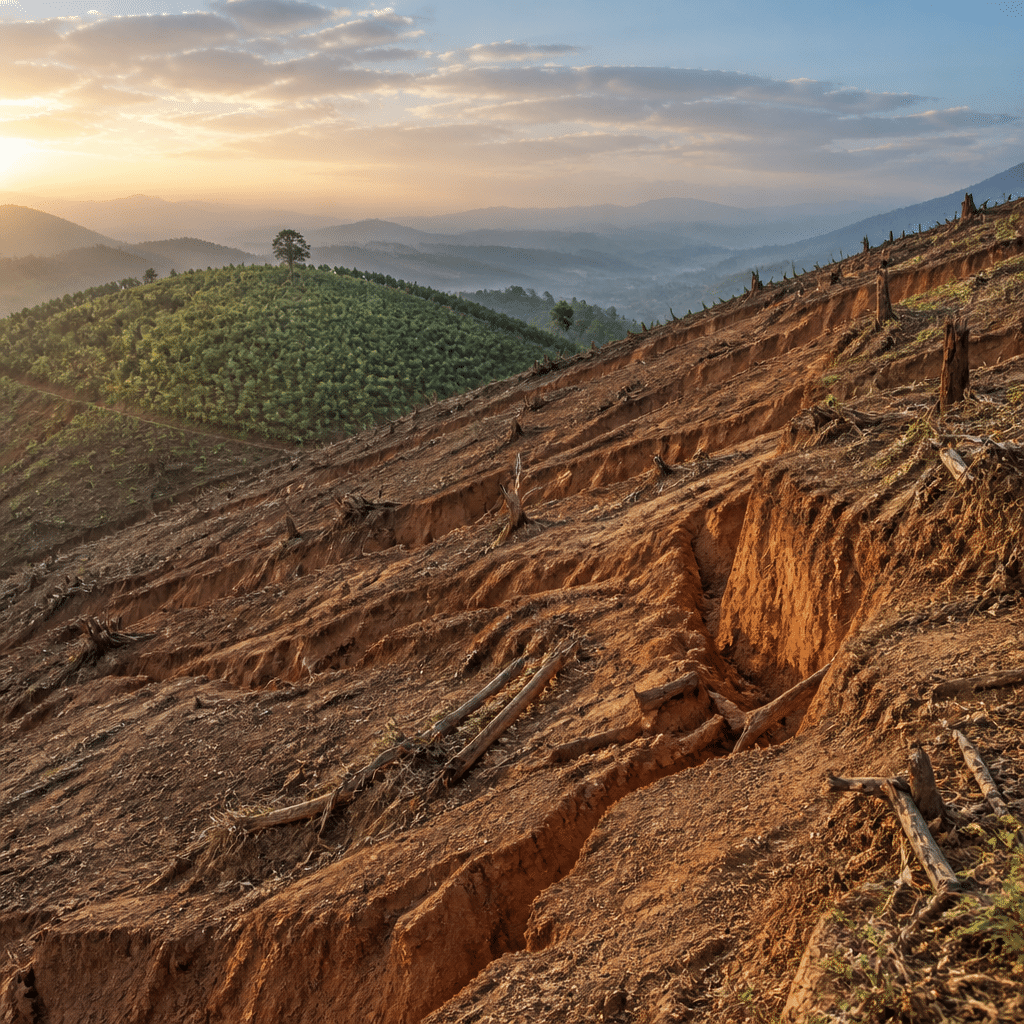
Haiti is ranked among the most climate-vulnerable countries in the world, not because it is a major contributor to global greenhouse gas emissions, but because of a devastating combination of geographic exposure, stripped-bare land, and decades of institutional neglect. Fewer than three percent of the country retains meaningful forest cover, 25 of 30 watersheds are completely deforested, and every hurricane season arrives on a landscape that is essentially defenseless against flooding and erosion. Building genuine Haiti climate resilience requires confronting that reality directly, not with emergency relief cycles, but with community-rooted action that restores land and strengthens local capacity. That is the work Community2Community (C2C) has been doing for over twelve years through the C2C Collaborative Framework.
| Key Insight | Explanation |
|---|---|
| Haiti is the most climate-vulnerable country in Latin America and the Caribbean | Its exposure to hurricanes, floods, and droughts is compounded by deforestation, poverty, and limited infrastructure, not by high emissions. |
| SDG 13 (Climate Action) and SDG 15 (Life on Land) are inseparable in Haiti | Restoring forest cover directly reduces flood risk and soil erosion, making land restoration a frontline climate adaptation tool. |
| 25 of 30 Haitian watersheds are completely deforested | This means almost every community in Haiti loses topsoil and clean water every rain season, making reforestation a survival issue, not an aesthetic one. |
| Community ownership determines whether reforestation lasts | Seedlings planted by external teams without community buy-in rarely survive more than one dry season. C2C’s model builds ownership before planting begins. |
| Foreign aid dependency actively undermines climate resilience | Communities reliant on external food and water supply cannot sustain adaptation measures when funding dries up. Self-sufficiency is a resilience strategy. |
| C2C’s Reforestation Initiative directly targets SDG 15 outcomes | Partner communities have planted 14,000 seedlings to protect water sources, stabilize slopes, and support food security simultaneously. |
| Agroforestry links food security to land protection | Combining trees with food production means communities have an economic reason to maintain forest cover rather than clearing it for charcoal. |
Haiti’s climate vulnerability is not an accident of geography alone. It is the product of compounding crises: a hurricane belt location, mountainous terrain that funnels rainfall into fast-moving flash floods, and a land surface that has been stripped of the trees that once absorbed, slowed, and filtered that water. Deforestation is the single most important amplifier of climate risk in Haiti, and it is a problem that foreign emergency aid has historically made worse by failing to address the root causes driving charcoal production.
According to UNDP data, rapid deforestation at roughly 1,000 hectares per year between 2005 and 2010 left only around three percent of Haiti with meaningful forest cover. Fuelwood and charcoal account for approximately 71 percent of Haiti’s energy requirements, which means families are burning trees not because they want to destroy the landscape, but because they have no affordable alternative. Until communities have sustainable livelihoods and alternative energy sources, tree-planting campaigns without economic integration will always lose the battle.
Haiti sits directly in the path of Atlantic hurricanes, with the most severe storm season running from June through October. Every flood that follows a storm travels faster, carries more sediment, and causes more destruction on a deforested slope than it would on a forested one. The UN Environment Programme’s Interactive Country Fiches confirm that Haiti’s combination of elevated exposure, high sensitivity, and poor response capacity places it among the most climate-vulnerable countries on the planet, despite contributing minimally to global emissions.
The countries least responsible for climate change are often the ones paying the highest price. In Haiti, that price is measured in topsoil lost, wells silted up, and harvests destroyed, year after year.
SDG 13 calls for urgent action to combat climate change and its impacts. For a country like Haiti, that does not primarily mean cutting emissions. It means building the capacity of communities to survive, adapt, and recover from climate shocks that are already happening. The distinction matters enormously for how organizations design and fund their programs.
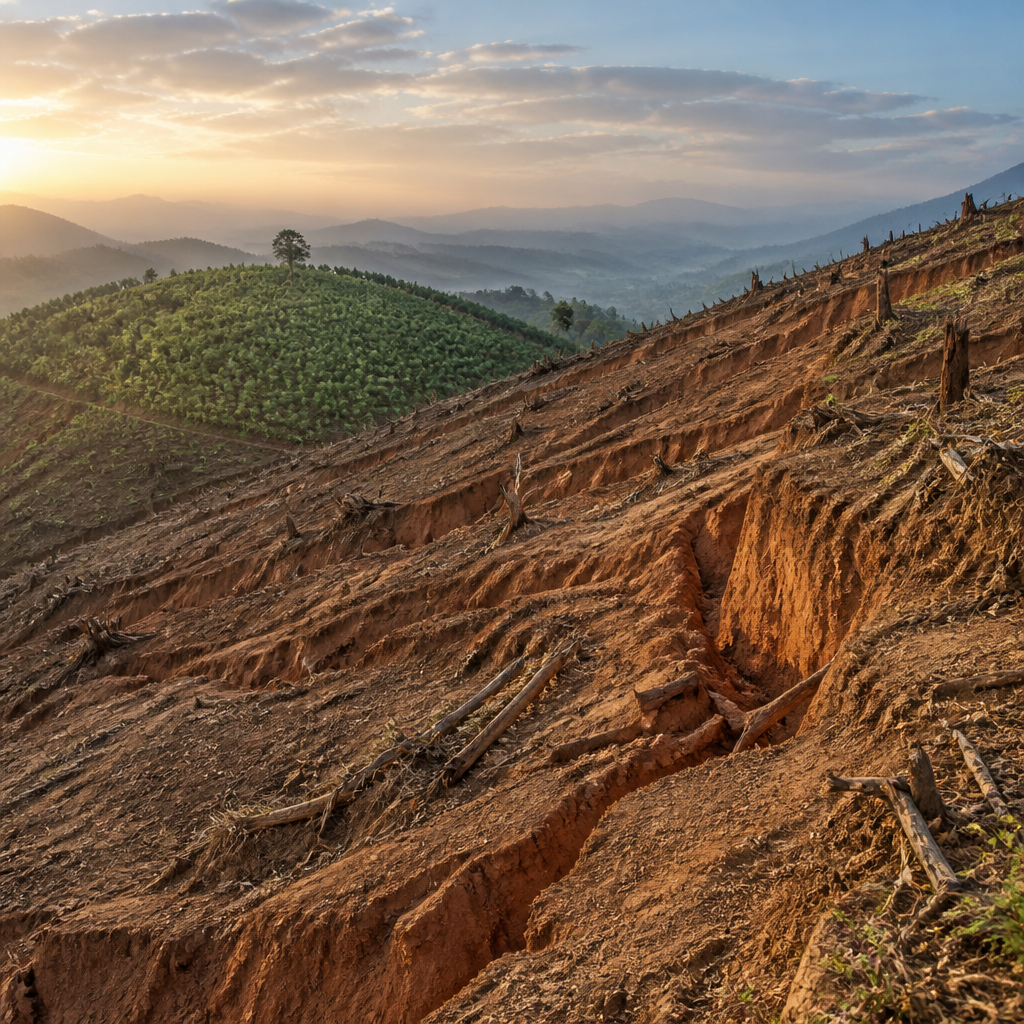
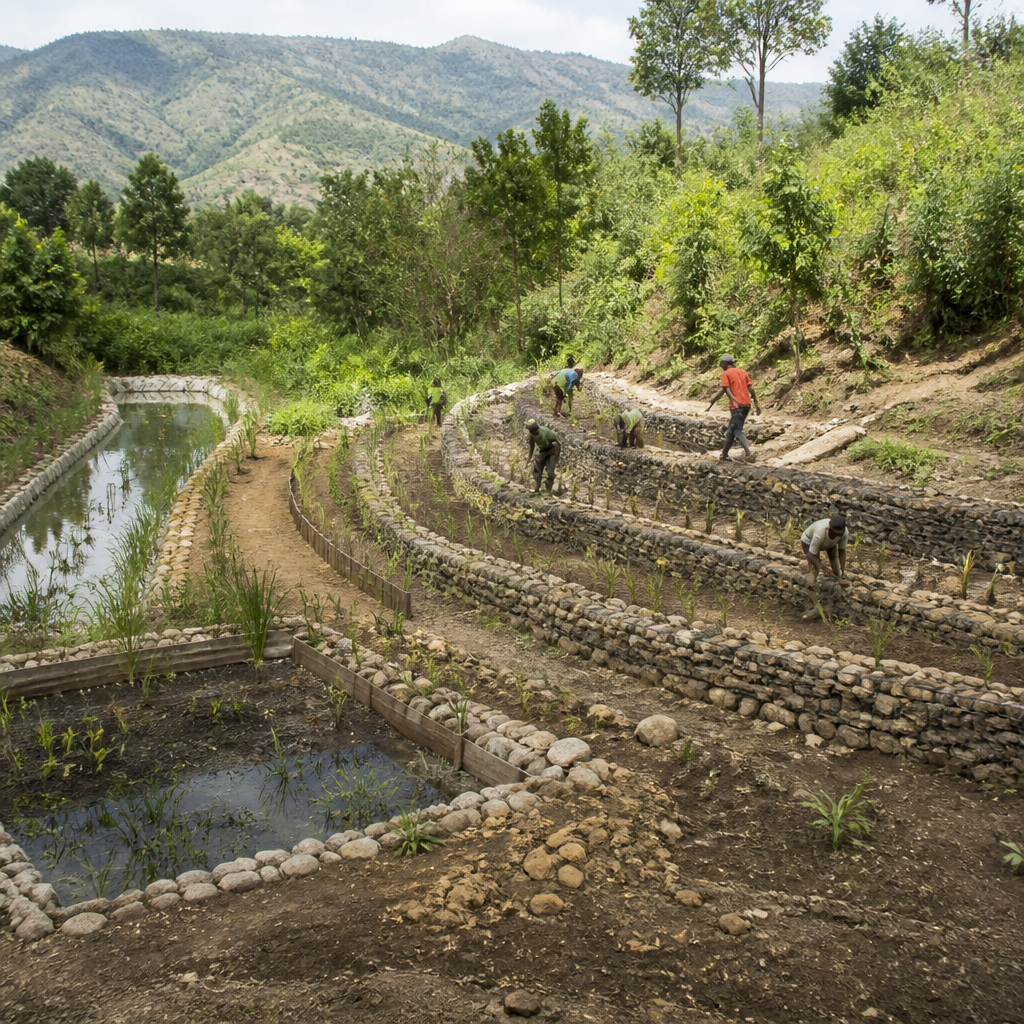
Haiti contributes a negligible fraction of global greenhouse gas emissions. Framing SDG 13 work in Haiti as a mitigation project misses the point entirely. The real work is adaptation: building flood-resistant infrastructure, securing water sources through watershed restoration, diversifying food production to survive erratic rainfall, and giving communities the skills and resources to respond without waiting for external intervention.
C2C’s approach aligns tightly with this adaptation framing. The Water Initiative, the Reforestation Initiative, and the Education Initiative are not parallel programs. They are interlocking parts of a system designed to reduce a community’s vulnerability to the climate shocks that will keep coming regardless of what happens to global emissions in the next decade.
One consistent finding across Haiti-focused climate work is that limited institutional capacity at the community level is as much a barrier as the physical damage from storms and floods. Communities that cannot plan, document, advocate, or manage resources cannot sustain adaptation measures between disaster events. C2C’s model deliberately builds that capacity. Partner communities are not aid recipients. They are co-designers and co-implementers of every initiative, which means the institutional knowledge stays in the community when external partners move on.
Pro tip: If you are evaluating whether a Haiti development program genuinely addresses SDG 13, ask one question: what happens to the program’s outcomes if the external organization withdraws funding for two years? If the honest answer is “everything stops,” the program is relief, not resilience.
SDG 15, Life on Land, focuses on protecting, restoring, and promoting the sustainable use of terrestrial ecosystems. In Haiti, there is no more urgent SDG 15 priority than reversing the collapse of forest cover and watershed function. This is not an environmental nicety. It is the physical foundation on which every other development goal in Haiti depends.
When a hillside loses its tree cover, several things happen in sequence. Topsoil washes away in the first heavy rain, permanently reducing the fertility of land that families depend on for food. Springs and wells that were recharged by slow percolation through forested ground begin to run dry or run muddy. Flash floods that once moved through a landscape more gently now arrive suddenly and with destructive force. Crops fail. Children get sick from contaminated water. Families who might have stayed on their land migrate to urban areas, compounding pressure on cities that are already overwhelmed.
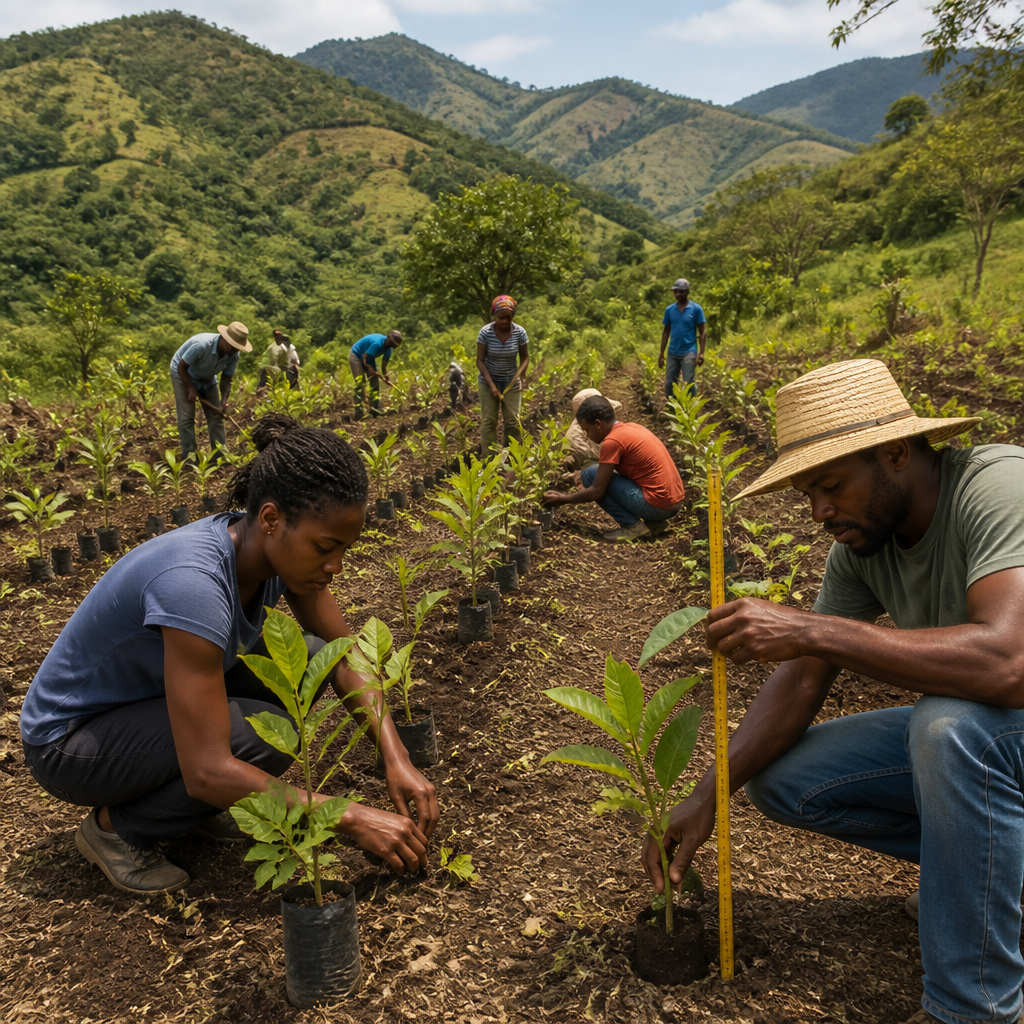
This is not a hypothetical sequence. It describes the lived experience of communities in Haiti’s mountainous interior, and it is precisely why C2C’s partner community planted 14,000 seedlings with a deliberate dual purpose: to protect community water sources and to begin stabilizing the hillside for sustainable agriculture.
Agroforestry, combining tree crops with food production, is the most durable form of reforestation available in a low-income context because it gives land users an economic reason to maintain tree cover. A farmer who plants fruit trees, nitrogen-fixing species that improve soil, or timber trees alongside staple crops has a direct financial stake in keeping those trees alive. Pure reforestation programs that plant trees on land where families urgently need food tend to fail within one growing season. C2C’s integration of reforestation with agricultural development and food security support addresses this practical reality.
Pro tip: Donors evaluating reforestation projects in Haiti should look for survival rates at 18 to 24 months post-planting, not just planting totals. A program that plants 100,000 seedlings with a 10 percent survival rate delivers less ecological restoration than a program that plants 14,000 seedlings with 80 percent survival through genuine community ownership.
The C2C Collaborative Framework is not primarily described as a climate program. It is a community-led development model. But the two are inseparable in practice, because the things that make a community self-sufficient, reliable water, productive land, educated people, and strong local institutions, are exactly the things that make it resilient to climate shocks.
Access to clean water in Haiti is both a development priority and a climate adaptation challenge. When deforested watersheds can no longer reliably filter and store rainfall, communities lose their water supply every dry season and face flooding every wet season. C2C’s Water Initiative works within partner communities to secure clean water access in ways that are maintained by the community itself. Protecting the forested areas around water sources is an integral part of this work. A water source without a functioning watershed is a temporary solution.
The Reforestation Initiative operates as a direct SDG 15 intervention. The 14,000 seedlings planted by C2C’s Mountainside Partner Community were selected and placed with a specific ecological function in mind: protecting water sources, stabilizing slopes, and supporting sustainable farming practices. This is not a symbolic gesture. It is land management designed by people who live with the consequences of getting it wrong.
What separates this from large-scale externally managed tree-planting programs is accountability. When a partner community plans and executes reforestation, community members know which plots were planted, who is responsible for maintenance, and what the trees are for. That knowledge does not evaporate when a project period ends.
Long-term environmental sustainability in Haiti requires that the next generation understands why forests matter and how to manage land sustainably. C2C’s Education Initiative supports partner community schools where students can engage with topics including reforestation, environmental stabilization, and agriculture. A child who grows up understanding the relationship between trees, water, and food security is a more effective steward of their landscape than any externally funded awareness campaign.
Not all climate resilience programs in Haiti take the same approach. The comparison below reflects the real difference between community-led models and the more common top-down project structures that dominate international development funding.
| Approach | Community-Led Model (C2C) | Standard Top-Down Aid Project |
|---|---|---|
| Who plans the project | Partner community with C2C support and co-design | External organization, often with limited local input |
| Reforestation survival rates | Higher due to community ownership and maintenance responsibility | Often low; trees planted without ongoing local stewardship |
| Water infrastructure ownership | Community manages and maintains systems directly | Dependent on external technicians and repair funding |
| Resilience after funding gap | Programs continue because communities own the knowledge and assets | Programs typically stall or collapse without continuous external funding |
| SDG alignment | Addresses SDG 13, 15, 1, 2, 3, 4, 6 simultaneously through integrated design | Often siloed to one or two SDG targets per project cycle |
| Dignity and agency | Communities are decision-makers; reliance on foreign aid actively reduced | Communities are recipients; reliance on aid often reinforced |
The biggest failure mode in environmental work in Haiti is treating ecological problems as separate from economic ones. Families do not choose charcoal over trees because they are indifferent to the environment. They choose charcoal because it is the only affordable fuel available to them. They clear slopes for planting because they need to feed their children this season, not because they are unaware that erosion will reduce their productivity next decade. Any approach to environmental sustainability in Haiti that does not address the economic pressures driving land degradation is treating symptoms.
C2C’s model is built on the understanding that self-sufficiency and ecological sustainability are the same goal approached from different angles. A community that has reliable clean water, productive land, and food security does not need to denude its hillsides to survive the next dry season. Reducing dependency on foreign aid is not just a dignity argument. It is an environmental strategy.
The comparison with emergency-relief-first approaches is instructive. When a hurricane hits and the response is to flood a community with external food, water, and materials, the immediate suffering is reduced but the structural conditions that made the community so vulnerable remain intact. Repeated over years, this cycle actively prevents communities from building the local capacity they need to be less vulnerable next time. The UNDP’s own Haiti climate data acknowledges that limited response capacity is as significant a vulnerability factor as physical exposure.
For donors and philanthropists focused on Haiti, the SDG 13 and SDG 15 agenda offers a clear lens for evaluating where investments will have lasting impact versus where they will simply fund another project cycle.
The most direct action is funding programs that integrate land restoration with livelihood development. Reforestation that comes with agricultural support, water security, and education backing has compounding ecological and social benefits. A donor who funds C2C’s Reforestation Initiative is not only planting trees. They are protecting a water source, supporting food production, and building the institutional capacity of a community to manage its own landscape for generations.
Equally important is shifting away from measuring impact in inputs, such as dollars spent or seedlings planted, toward outcomes: water sources protected, slope stability measured, food security sustained, and community capacity documented. C2C’s approach to community-led development makes this kind of outcome measurement possible because the community itself can report on what changed and why.
Donors who want to understand C2C’s current initiatives, partner communities, and how their investment connects to specific SDG targets can explore the full scope of the work at c2chaiti.org/initiatives. For those interested specifically in how C2C addresses Haiti’s structural challenges through community partnership, the C2C approach page lays out the Collaborative Framework in practical terms.
Climate vulnerability has three components: physical exposure to climate events, sensitivity to their impacts, and the capacity to respond and recover. Haiti scores extremely high on all three. Its location in the Atlantic hurricane belt creates constant exposure. Deforestation, poverty, and inadequate infrastructure make the impacts of each storm or drought far worse than they would otherwise be. And limited institutional capacity, both at the community and national level, means recovery is slow and incomplete. Haiti contributes minimally to the emissions driving global warming, but it bears a disproportionate share of the consequences.
Forests slow rainfall, reduce flood peaks, filter water into aquifers, hold topsoil in place, and moderate local temperatures. When forests are removed, all of those functions disappear. Flash floods intensify, springs run dry, and soils erode. In Haiti, where roughly 25 of 30 watersheds have been completely deforested, the land is essentially unable to buffer the climate shocks that arrive every hurricane season. Reforestation is therefore not a secondary environmental concern. It is the foundation of climate resilience.
C2C’s Reforestation Initiative directly targets SDG 15 by restoring tree cover and protecting water sources in partner communities, with 14,000 seedlings planted in the Mountainside Partner Community as a documented example. The Water Initiative supports both SDG 6 and SDG 13 by securing clean water access in ways that are resilient to climate variability. The Education Initiative builds the long-term environmental literacy needed for communities to manage their own land sustainably, which underpins SDG 15 outcomes over time. Taken together, the C2C Collaborative Framework addresses SDG 13 adaptation goals by building the exact capacities, local knowledge, stable land, and reliable water, that determine whether a community survives a climate shock.
Community-led reforestation works because maintenance accountability stays with the people who live on the land. When a community plans where trees go, selects species that serve their agricultural and water needs, and understands why the planting matters for their water supply and food security, they have concrete reasons to protect those trees through dry seasons, through political transitions, and through the gaps between project funding cycles. External planting programs often generate impressive initial numbers but suffer poor survival rates because the community has no ownership stake in the outcome. The trees are planted on their land, but the project belongs to someone else.
The key is funding programs that build capacity rather than deliver services. Donating to a program that provides water to a community is aid. Donating to a program that builds a community-owned water system, trains local maintenance technicians, and integrates watershed protection into the design is a resilience investment. C2C’s model is specifically structured to reduce reliance on foreign aid over time. Donors who support C2C are funding the development of community institutions, skills, and assets that persist after the funding relationship ends. That is the meaningful difference between charity and development.
Fuelwood and charcoal account for the vast majority of Haiti’s domestic energy use. Families who cannot afford alternative cooking fuel sources have no realistic option other than to use wood. This creates continuous pressure on remaining forest cover regardless of how many trees are planted. Sustainable solutions require addressing both sides of the equation: restoring tree cover through agroforestry and reforestation, and simultaneously reducing the economic pressure to cut trees by building livelihoods that do not depend on charcoal production. This is why C2C’s integrated model, which links reforestation to agricultural development and food security, is more durable than single-issue tree-planting approaches.
If you are working on Haiti development, advocating for climate-resilient programming, or evaluating where to direct your philanthropic resources, we would value your perspective: what aspects of community-led climate resilience do you find most compelling or most difficult to communicate to funders?