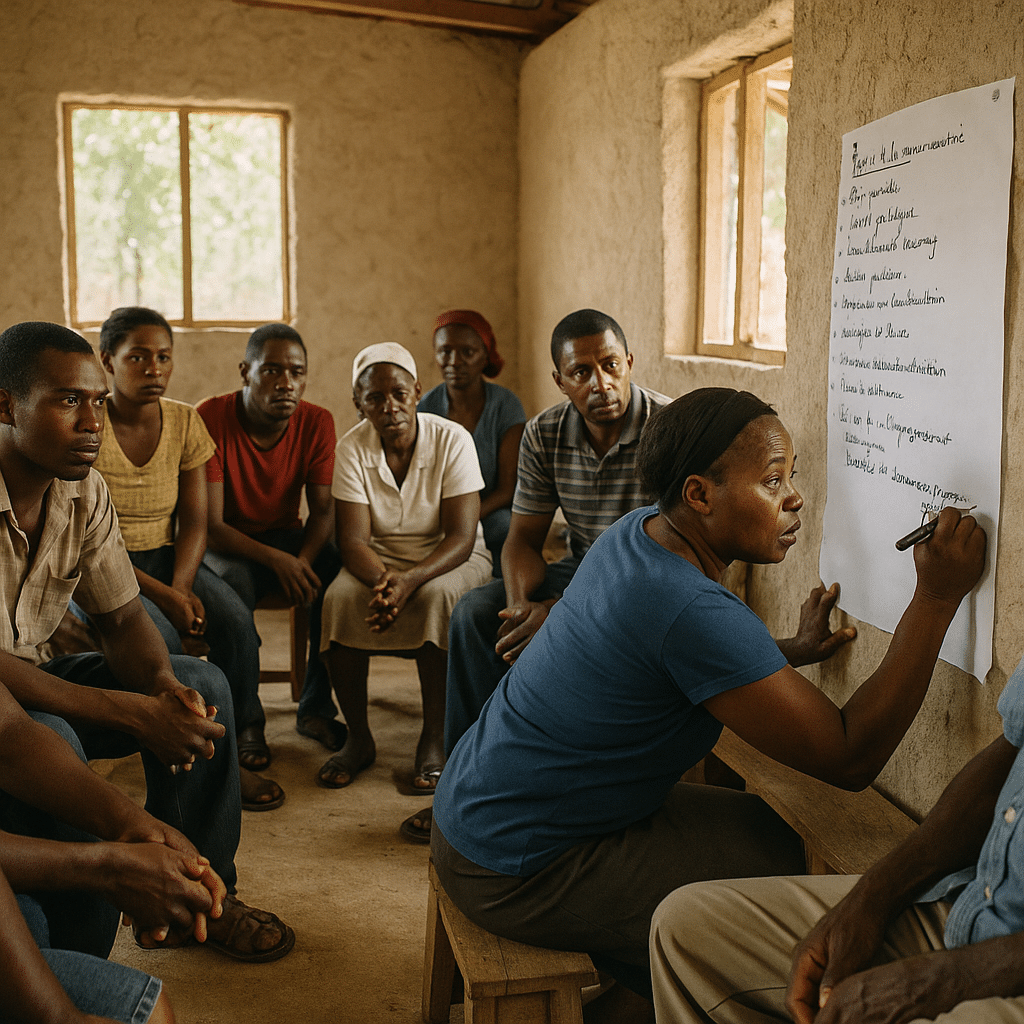
Over the past 30 years, Haiti has received more than $13 billion in international aid. Yet by most measurable indicators, food insecurity, poverty rates, and institutional dependency have deepened rather than improved. The uncomfortable truth that the development sector avoids is this: traditional foreign aid as it is currently designed frequently fails the people it claims to serve. Community-led development in Haiti offers a structurally different answer, one grounded in local ownership, accountability, and self-determination rather than donor-driven agendas and short-term project cycles.
| Key Insight | Explanation |
|---|---|
| Aid dependency is measurable and harmful | Decades of traditional aid in Haiti have increased institutional dependency rather than reducing it, leaving communities less resilient after each crisis. |
| Community ownership changes project outcomes | When Haitian communities design and lead their own development projects, maintenance rates and long-term impact improve significantly compared to externally managed programs. |
| Short project cycles destroy continuity | Most foreign aid programs operate on 1 to 3 year funding cycles, which prevents the kind of multi-year trust-building that sustainable development in Haiti requires. |
| Local knowledge is irreplaceable | Haitian communities understand local land conditions, social dynamics, and governance structures that outside organizations routinely misread or ignore. |
| Donor accountability must shift inward | Traditional aid is accountable upward to donors and governments. Community-led models are accountable downward to the people they serve, which changes incentives entirely. |
| Foreign aid alternatives require patient capital | Community-led development does not deliver photo-ready results in 90 days. Donors who want lasting impact must commit to longer timeframes and trust local leadership. |
| Self-sufficiency is a design choice, not a byproduct | Effective sustainable development in Haiti builds local capacity deliberately into every project phase, rather than treating it as a hoped-for future outcome. |
Haiti is not a country that lacks international attention or international funding. It is a country where that funding has consistently been structured in ways that bypass the people it was supposed to benefit. Understanding why requires looking at the structural incentives inside traditional aid organizations, not just their intentions.
In practice, most large international NGOs operating in Haiti are accountable first to their donors and their home governments, not to Haitian communities. This accountability gap shapes every decision: what gets funded, how success is measured, and who controls the money. When a program ends, the infrastructure it built often deteriorates because communities had no ownership in creating it and no resources to maintain it.
The 2010 earthquake response is the most thoroughly documented example of this failure. The Red Cross raised nearly $500 million for Haiti earthquake relief and, according to an investigation by ProPublica and NPR, built only six permanent homes. Billions of dollars flowed through Port-au-Prince and into the accounts of international contractors while local Haitian firms, local leaders, and local expertise were largely excluded from decision-making.
This was not a funding problem. It was a design problem. The model itself prioritized rapid, visible deployment over durable, community-integrated results. And Haiti has been rebuilding from that model ever since.
Pro tip: When evaluating any Haiti-focused organization, ask specifically what percentage of program decisions are made by Haitian community members versus external staff. That single question reveals more about an organization’s model than any annual report will.
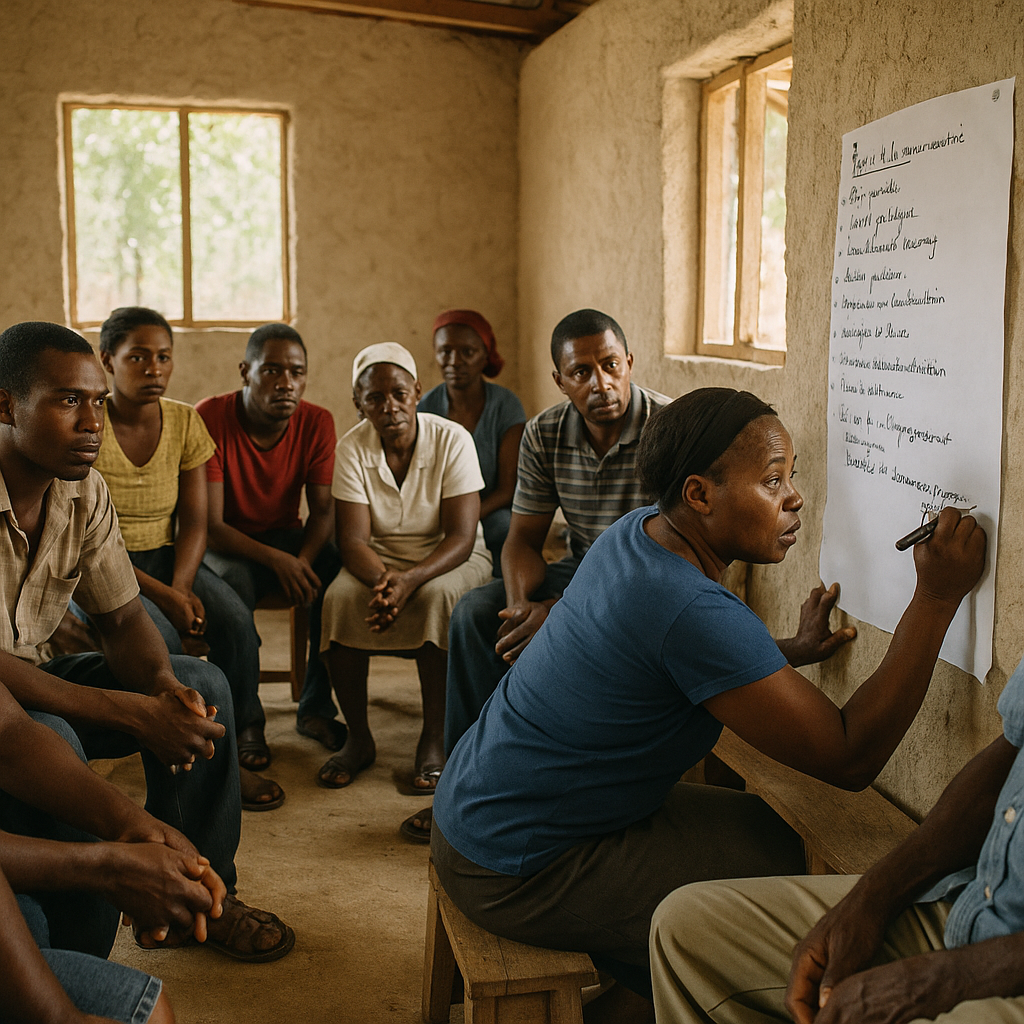
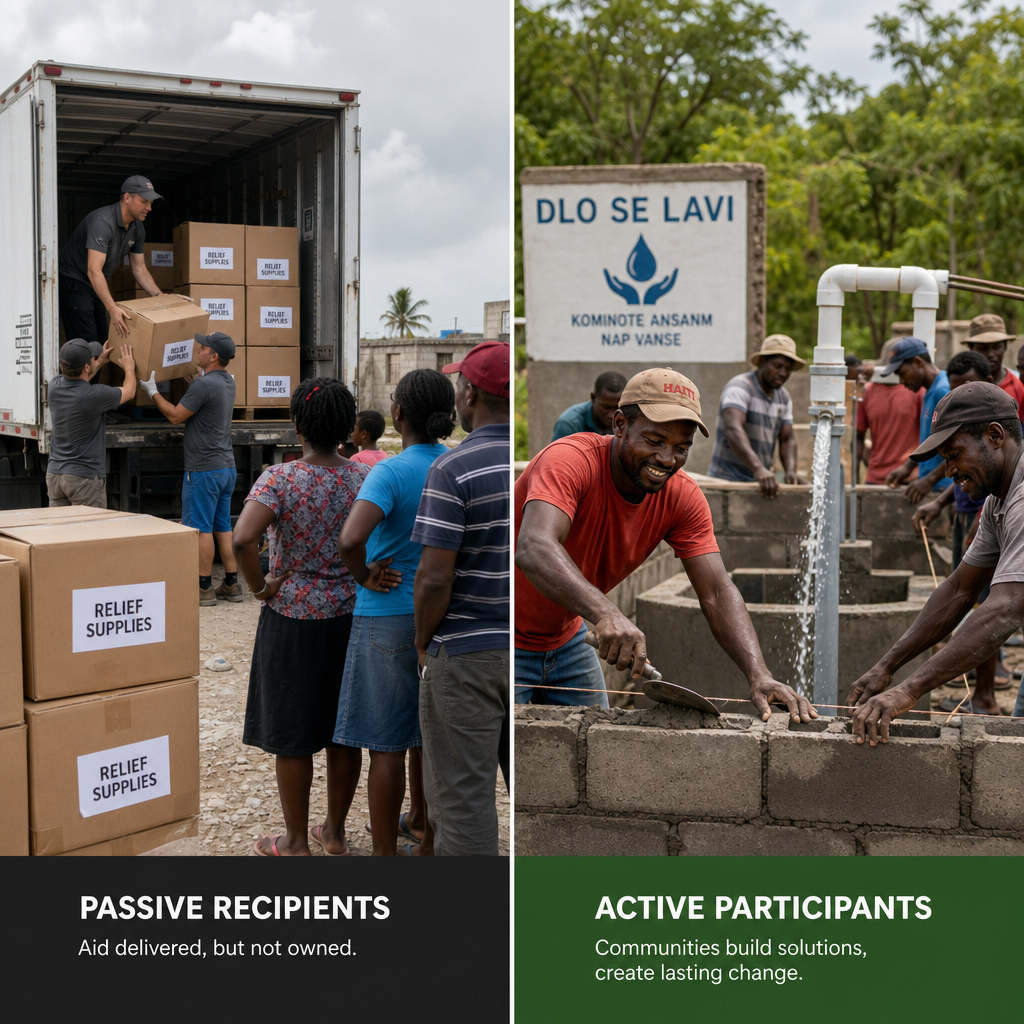
Community-led development is not a softer version of traditional aid with more local staff in the room. It is a fundamentally different power structure. In a community-led model, the community itself identifies the priorities, designs the interventions, manages the resources, and owns the outcomes. The external organization serves as a partner and a capacity-builder, not a decision-maker.
This distinction matters because it changes where accountability sits. When a Haitian community has genuine authority over a water project or a school construction initiative, they have a direct stake in whether it works. They are not waiting for a foreign organization to return and fix it. They are the ones who built it and the ones who will maintain it.
A common mistake in international development is confusing participation with ownership. Many traditional aid programs include community members in consultations or local labor pools, then describe this as community involvement. But involvement without authority is not ownership. Real ownership means communities can say no to a proposed project, redirect funds when priorities change, and hold their own leadership accountable for results.
The data consistently shows that projects with genuine community ownership have significantly higher maintenance and sustainability rates. A 2019 World Bank analysis of water and sanitation projects found that community-managed schemes were far more likely to remain functional five years after completion compared to externally managed equivalents in similar low-income contexts.
“Development that is done to communities rather than by communities tends to create exactly the dependency it was designed to eliminate.” – Dambisa Moyo, economist and author of Dead Aid
The case for community-led development in Haiti is not theoretical. There is a growing body of rigorous evidence comparing community-managed programs against traditional aid delivery across health, education, water access, and agricultural productivity in low-income countries including Haiti specifically.
According to a McKinsey Global Institute report on development effectiveness, programs that embed local institutional capacity from the start achieve sustainability rates two to three times higher than those relying on external implementation. This gap grows wider in fragile states, which is exactly the context Haiti operates in.
In education, externally funded schools in Haiti frequently struggle with teacher retention and parent engagement when funding organizations exit. Community-built schools where parents and local governance structures made construction decisions show measurably better enrollment continuity and attendance rates.
In health, community health worker programs that are recruited and supervised locally rather than by outside NGOs have consistently outperformed external programs in rural Haiti on vaccination coverage and maternal health visits. This holds even when the community programs operate with smaller budgets, because local trust networks reduce the friction costs that outside organizations cannot eliminate.
Pro tip: When comparing aid organizations working in Haiti, look for multi-year outcome data rather than input data such as dollars spent or people reached. Input metrics tell you what was deployed. Outcome metrics tell you what actually changed.
Community2Community operates on a model called the C2C Collaborative Framework, which structurally embeds the principles of community-led development into every phase of its work in Haiti. This is worth examining in practical terms because it shows what these principles look like when applied to real projects rather than theoretical proposals.
Under the C2C model, partner communities are not recipients. They are co-designers. Community leaders are involved from initial needs assessment through project planning, implementation, and evaluation. C2C does not arrive with a predetermined solution and ask for buy-in. It arrives with a process and works alongside communities to determine what the solution should be.
C2C’s work directly addresses United Nations Sustainable Development Goals including poverty elimination (SDG 1), good health (SDG 3), quality education (SDG 4), and sustainable infrastructure (SDG 9). But the critical distinction from traditional aid is that C2C builds toward the point where communities no longer need C2C. That self-sufficiency endpoint is a design goal, not a vague aspiration.
This stands in direct contrast to organizations whose operational incentives depend on ongoing dependency. When an organization’s revenue is tied to maintaining a program presence, the structural incentive pushes against genuine community empowerment. C2C’s model inverts that incentive by measuring success in terms of reduced reliance on external support over time.

The following table compares three distinct approaches to development work in Haiti based on their structural design, not their stated mission. Intentions matter, but structure determines outcomes.
| Approach | Decision-Making Authority | Long-Term Sustainability |
|---|---|---|
| Traditional Foreign Aid (e.g., large NGO-led programs) | External organization and donor governments hold primary authority. Community input is consultative at best. | Low. Projects frequently deteriorate after funding cycles end because communities have no ownership infrastructure. |
| Hybrid Models (e.g., Global Communities approach) | Shared, but external partners often retain veto authority. Local leadership is incorporated but not primary. | Moderate. Better than pure top-down aid, but dependency on external technical assistance often persists. |
| Community-Led Development (e.g., C2C Collaborative Framework) | Community leaders hold primary authority. External partners serve an advisory and capacity-building function. | High. Communities maintain, adapt, and expand projects because they designed and own them from the start. |
International donors and philanthropists who care about Haiti face a choice that most fundraising materials obscure: they can fund visible activity, or they can fund durable change. These are not the same thing, and in Haiti’s development context they often point in opposite directions.
Visible activity looks like food distribution trucks, temporary shelter construction, and school supply drives. These generate compelling photographs and clear metrics. They also frequently create the dependency cycle that makes communities more vulnerable to the next crisis rather than less.
Funding community-led development in Haiti requires donors to accept two things that feel uncomfortable. First, timelines are longer. Building genuine community capacity to manage infrastructure, govern resources, and sustain programs takes years, not months. Second, control is lower. In a community-led model, donors do not determine what gets built. Communities do. Donors who need to specify outcomes in advance are funding their own vision, not Haiti’s.
The most effective donors in this space shift from project-specific grants to organizational trust. They fund the capacity of organizations like C2C to deepen their community partnerships rather than demanding that each dollar be tied to a measurable deliverable defined from the outside.
Foreign aid alternatives for Haiti are not about removing external support. They are about redesigning what that support does and who controls it. Several proven mechanisms exist that funnel resources into Haitian communities without replicating the dependency structures of traditional aid.
Direct community grants, where funding goes to community-formed governance bodies rather than international NGOs, consistently produce higher local ownership. Matched savings programs that build household assets while contributing to community infrastructure funds have demonstrated strong results across Sub-Saharan Africa and increasingly in Caribbean contexts. Capacity-building fellowships that train Haitian professionals in project management, financial governance, and technical skills create institutional depth that outlasts any single project.
The Haitian diaspora sends approximately $3.8 billion in remittances to Haiti annually, according to World Bank data. This dwarfs official development assistance by a significant margin. Yet formal development organizations have barely scratched the surface of channeling diaspora investment into structured community development initiatives. Organizations that build authentic diaspora-community partnerships are tapping a foreign aid alternative that is already motivated, already culturally grounded, and already flowing.
Sustainable development in Haiti is not a single project with a defined end date. It is a gradual, deliberate shift in the capacity of Haitian communities to govern their own resources, manage their own infrastructure, and advocate for their own priorities within national and international systems.
In practice, this means organizations like C2C are working toward communities that no longer require a partner organization to function. A school that Haitian families helped design and build is maintained because the community understands its value and has the governance structures to fund repairs. A water system that community engineers helped install is managed because local technical capacity exists to diagnose and fix problems.
Aid-built infrastructure in Haiti has a documented failure rate that receives far less attention than the original construction announcements. Latrines, water pumps, and solar installations funded by external programs frequently fall into disrepair within two to three years because communities were not trained to maintain them and no local supply chains exist for parts and repairs.
Community-led infrastructure projects account for maintenance from the beginning. They train local technicians, establish community maintenance funds, source materials locally where possible, and build repair capacity into the project design. This is less photogenic than a ribbon-cutting ceremony, but it is what determines whether the infrastructure still functions in 2035.
In the short term, yes. Building genuine community ownership and decision-making capacity takes more time upfront than deploying a predetermined program. But the relevant comparison is not speed of deployment. It is whether the results last. Community-led projects in Haiti consistently demonstrate higher long-term functionality because communities have a real stake in maintaining them. Speed without sustainability is waste.
Ask for community-level financial reports, not just organizational audits. Effective community-led organizations like C2C structure their reporting so that community partners have visibility into how resources are allocated and are involved in evaluating whether stated outcomes were achieved. If an organization cannot show you documentation that communities themselves reviewed and approved, that is a structural transparency problem worth taking seriously.
The core difference is where authority sits. Many organizations describe themselves as community-centered while retaining external control over funding, project design, and evaluation. C2C’s framework places community leaders in primary decision-making roles from the start of any engagement. The goal is explicitly to build toward communities that do not need C2C rather than to maintain a long-term program presence as proof of organizational relevance.
The evidence suggests it is actually more resilient in unstable conditions, not less. Communities with strong internal governance and local ownership of resources are better positioned to continue functioning during political disruptions than communities dependent on external organizations that may withdraw funding or staff when security conditions deteriorate. Local leadership does not evacuate when the situation becomes difficult.
Community-led development in Haiti addresses multiple SDGs simultaneously because the approach is holistic rather than siloed. SDG 1 (No Poverty) is addressed by building economic capacity within communities. SDG 3 (Good Health) is supported through locally governed health initiatives. SDG 4 (Quality Education) advances through community-built and maintained schools. SDG 6 (Clean Water) is pursued through locally managed water infrastructure. SDG 11 (Sustainable Communities) is the underlying architecture of the entire model.
The honest answer is organizational incentives. Large international NGOs have significant overhead structures, donor reporting requirements, and operational systems built around centralized control of resources and outcomes. Transitioning to genuine community authority would require these organizations to redistribute power they have institutionalized over decades. Some organizations are making incremental progress in this direction, but structural change in large institutions is slow and frequently resisted internally.
If you have supported development work in Haiti, either as a donor or a community partner, what has your experience revealed about which models actually produce lasting results? Share your perspective with us.