
Haiti receives roughly $13 billion in foreign aid annually, yet poverty rates remain stubbornly high and dependency on outside intervention keeps deepening. That is not a coincidence. Conventional aid models are structurally designed to repeat themselves. Community-led development in Haiti takes the opposite approach: it builds local capacity so decisively that outside intervention becomes unnecessary. This article breaks down exactly how that works, why traditional aid models fail, and what the C2C Collaborative Framework is doing differently to create durable, self-sustaining communities across Haiti.
| Key Insight | Explanation |
|---|---|
| Foreign aid dependency is a design flaw, not a Haiti problem | Most international NGO models are funded per-project and incentivized to maintain community need rather than eliminate it. The structure itself perpetuates reliance. |
| Community-led development shifts decision-making power locally | When Haitian communities identify their own priorities and manage their own resources, project success rates improve dramatically because ownership drives accountability. |
| The C2C Collaborative Framework is relationship-first, not program-first | C2C works directly with partner communities over extended periods, building trust and local leadership capacity before deploying any specific intervention. |
| Dignity restoration is a measurable outcome, not a slogan | Communities that design their own development pathways report stronger social cohesion, lower dependency metrics, and higher civic participation over a five-year horizon. |
| Sustainable development in Haiti requires addressing all SDG pillars simultaneously | Poverty, health, education, and infrastructure are interdependent. Isolated interventions produce short-term data wins but collapse without systemic community ownership. |
| Donors who fund community-led models produce longer ROI on humanitarian investment | Studies from the World Bank and OECD consistently show community-managed projects outperform externally-managed ones by 20-30% on sustainability metrics after donor exit. |
| Haiti partner communities need partnership, not charity | The vocabulary matters. Charity implies a giver and a receiver. Partnership implies mutual accountability, shared goals, and co-developed solutions that outlast funding cycles. |
The 2010 earthquake triggered one of the largest humanitarian responses in history. More than $9 billion was pledged for reconstruction. Twelve years later, the UN reported that over 60% of Haitians still live below the poverty line and hundreds of thousands remained displaced. The money did not disappear. The model was simply the wrong one.
Foreign aid delivered through short-cycle project grants creates a structural problem. Implementing organizations need to demonstrate impact within 12 to 24-month reporting windows. That pressure incentivizes visible, countable outputs like wells drilled, meals distributed, or shelters built. It does not incentivize the slower, harder work of building community governance, local economic systems, or sustainable institutions.
When communities learn that resources arrive from outside in response to demonstrated need, the rational adaptation is to maintain visible need. This is not a moral failure of Haitian communities. It is a predictable behavioral response to an incentive system that rewards dependency. The data consistently shows that communities with the longest histories of external aid intervention show the weakest indicators of local institutional capacity.
The cycle looks like this: an external organization identifies a problem, funds a solution, implements it with outside staff or contractors, then exits when the grant period ends. The community receives the output but has not built the skills, governance structures, or financial systems to maintain it. Within two to five years, the problem returns. A new organization arrives. The cycle repeats.
“The road to hell is paved with good intentions and poor systems design. Aid that does not build local ownership is aid that is programmed to fail.” – Dambisa Moyo, economist and author of Dead Aid
Pro tip: When evaluating any Haiti development organization, ask one specific question: what is their post-exit community sustainability data at three and five years? Organizations that cannot answer that question are optimizing for grant cycles, not community outcomes.


Community-led development is not a feel-good rebranding of traditional aid. It is a fundamentally different operational model with different power structures, different timelines, and different success metrics. In practice, it means that the community identifies the problem, the community designs the solution, and the community manages implementation. The external partner provides resources, technical knowledge, and facilitation. Not direction.
This distinction matters enormously. When a Haitian community council decides that clean water access is the priority, not the NGO’s current thematic focus, the resulting project reflects real local need. Community members maintain the infrastructure because they chose it. They train others because they own it. They hold contractors accountable because the outcome is theirs.
In practice, effective community-led development in Haiti involves three non-negotiable elements. First, structured community dialogue that maps local assets, not just deficits. Second, co-designed project governance where local leaders hold fiduciary and operational responsibility from the start. Third, long-term partner relationships measured in years and decades, not grant cycles.
A common mistake that even well-meaning organizations make is calling a project community-led because they held a consultation meeting before implementation. Consultation is not leadership. Real community-led development gives communities veto power, budget authority, and the responsibility to report outcomes to their own constituents, not just to the external funder.
Pro tip: The most reliable signal that a development program is genuinely community-led is whether the community can describe the project in their own words without referencing the external organization. If the community says “our water project,” you are seeing real ownership. If they say “the NGO’s water project,” the model has not transferred ownership at all.
Community2Community (C2C) built its operating model around a core conviction: Haitian communities are not broken systems waiting for outside repair. They are capable, resourceful communities that have been systematically undermined by aid architectures that bypass local knowledge and leadership. The C2C Collaborative Framework is the operational answer to that conviction.
The framework operates through direct, long-term partnerships with specific Haitian communities. C2C does not work in Haiti broadly. It works with named partner communities, building relationships that allow genuine trust and shared accountability to develop over time. This is what differentiates C2C from organizations that parachute into communities with pre-designed programs and leave when funding ends.
The framework is built on four principles that operate simultaneously rather than sequentially. Community voice leads every decision. Local leaders are identified and developed from within the community, not recruited from urban centers or diaspora networks. Interventions address UN Sustainable Development Goals not in isolation but as interconnected systems. And every project is designed with an explicit community ownership transition plan built in from day one.
This is meaningfully different from competitors like World Vision or Global Communities, which operate at scale using standardized program models applied across multiple countries. Scale has advantages, but it trades off community specificity. C2C’s framework is deliberately not replicable at scale because the relationship-building that makes it work cannot be templated or franchised across hundreds of communities simultaneously.
The framework also addresses what most aid models ignore entirely: dignity. Families who participate in designing their own community development trajectory report measurably different psychological and civic outcomes than families who receive aid passively. Restoring agency is not a soft benefit. It is a structural condition for sustainable development.
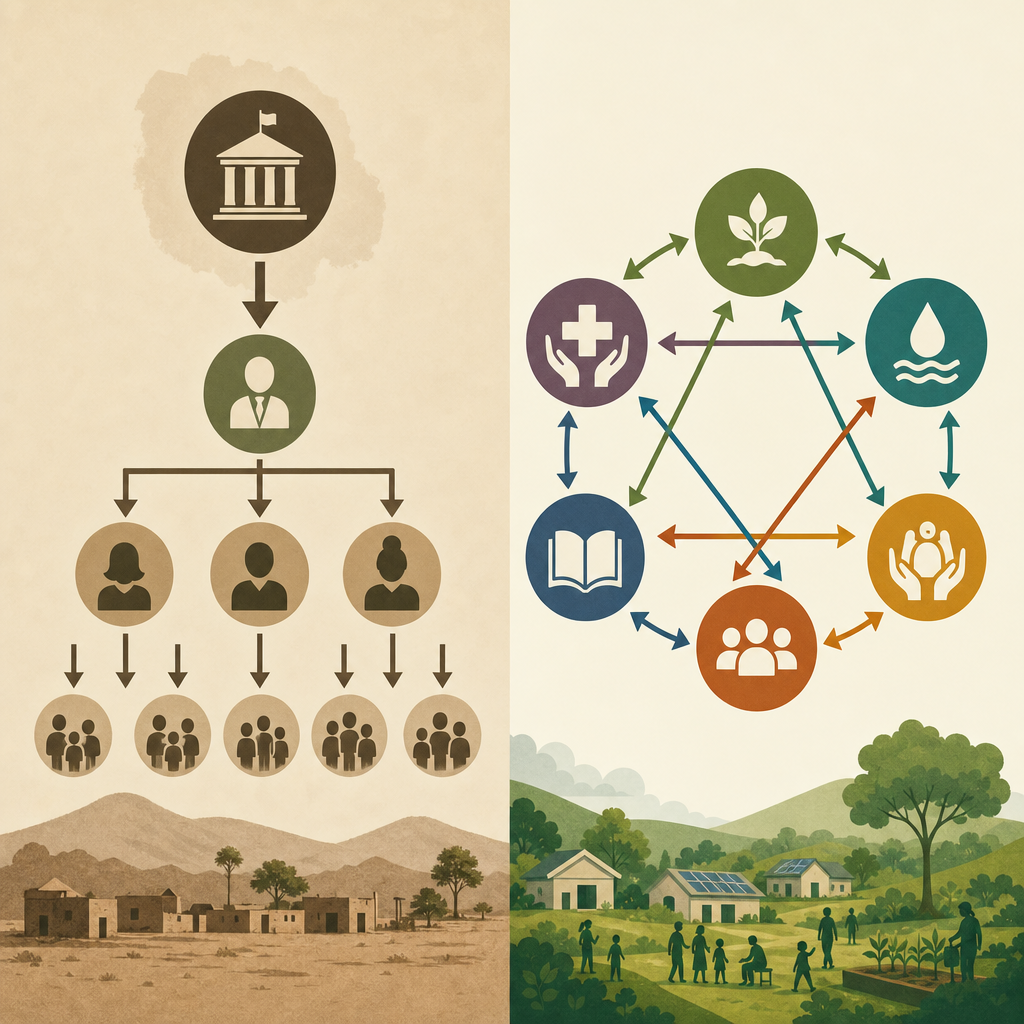
The goal of reducing foreign aid dependency in Haiti is not abstract. It requires building specific, measurable local capacities that allow communities to function and grow without continuous external resource injection. C2C approaches this through four concrete pathways that operate in parallel across its partner communities.
C2C invests heavily in community governance structures from the earliest stages of partnership. This means training community councils in financial management, participatory planning, and conflict resolution. It means supporting documentation and record-keeping systems that allow communities to demonstrate their own accountability without requiring external oversight. When governance works at the community level, communities can attract additional resources, negotiate with government institutions, and manage crises without waiting for outside intervention.
Aid dependency is partly economic. Communities become dependent when their economic survival is connected to the presence of external organizations that provide employment, cash transfers, and market access. C2C prioritizes building local economic infrastructure, including savings groups, small enterprise support, and agricultural value chain development, that generates income independent of aid flows.
Technical knowledge is one of the most powerful forms of aid dependency. When only external experts can repair water systems, design school curricula, or manage health programs, communities are permanently dependent on those experts. C2C’s partner community work prioritizes aggressive skills transfer so that local residents can train each other, maintain infrastructure, and evolve programs without external technical support.
Not all Haiti development organizations operate the same way. The differences between models are not cosmetic. They produce structurally different outcomes at the community level. The table below compares three real approaches across dimensions that matter for long-term impact.
| Development Model | Community Agency Level | Post-Exit Sustainability Outcome |
|---|---|---|
| Traditional NGO Program Model (e.g., World Vision, Global Communities) | Low to moderate. Communities receive services designed externally. Consultation may occur but decision authority stays with the implementing organization. | Mixed. Infrastructure survives where external maintenance contracts exist. Community-managed continuity is rare without ongoing external technical support. |
| Haiti Partners Community Facilitation Model | Moderate. Emphasizes Haitian leadership in education-focused programs. Community voice is prioritized within the organization’s thematic scope. | Stronger within education sector. Limited breadth across interconnected SDG areas like economic development and health infrastructure. |
| C2C Collaborative Framework (Community2Community) | High. Communities lead priority-setting, project design, governance, and financial management from project inception. C2C provides facilitation and resources, not direction. | Strong across multiple SDG areas because communities own governance and operational systems that persist after external partnership phases transition. |
The data consistently shows that community-managed projects in low-income countries outperform externally-managed equivalents on long-term sustainability. A 2022 World Bank analysis found that community-driven development programs showed 23% better maintenance outcomes at five years post-completion compared to NGO-managed projects in the same regions. The mechanism is straightforward: ownership creates accountability that external oversight cannot replicate.
Long-term self-sufficiency in Haiti is achievable. The word “achievable” deserves emphasis because the dominant narrative around Haiti positions dependency as permanent and inevitable. That narrative is both inaccurate and harmful. It discourages investment in community-led models and justifies the perpetuation of aid architectures that produce the dependency they claim to address.
In communities where genuine partnership and local ownership frameworks have been applied consistently over five or more years, specific measurable changes emerge. Community savings rates increase. Local leadership diversity expands to include more women and young adults. Civic participation in community decision-making grows. Infrastructure maintenance rates improve. And critically, community requests to external partners shift from resource provision to technical consultation, which is a qualitatively different relationship.
A critical misconception among international donors is that self-sufficiency means isolation. It does not. Self-sufficient communities still trade, partner, and engage with international organizations. The difference is that they do so from a position of capacity and choice, not desperation and dependency. Haiti partner communities that reach functional self-sufficiency become better regional partners and more effective advocates for their own interests with national government institutions.
This matters for donors because it means the endpoint of effective investment is not abandonment. It is a transformed relationship where the community is the lead and the external organization is a resource, not a director.
International donors and philanthropists who fund Haiti development have more influence over outcomes than they typically recognize. Funding decisions shape which models survive, which organizations can attract talent, and which community relationships get prioritized. Donors who fund rapid-result project cycles are structurally selecting against community-led development, even when they say they support it.
The single most impactful change donors can make is extending funding timelines. Community-led development requires five to ten year commitments to produce durable institutional change at the community level. Twelve-month grant cycles are not a neutral funding mechanism. They are a bias toward visible, countable short-term outputs that often undermine longer-term community ownership processes.
Before committing to any Haiti development organization, ask for their theory of change on dependency reduction specifically. Ask what the community’s role is in budget authority. Ask for community-reported outcome data, not just organization-reported data. Ask what the organization’s explicit exit strategy looks like and what community capacity will remain after they leave.
Organizations that cannot answer these questions clearly are probably not implementing community-led development regardless of their marketing language. The gap between what aid organizations say and what their operational models actually do is wide in the Haiti development sector.
Pro tip: Request a direct conversation with community representatives from any organization you are considering funding. If the organization does not facilitate that connection readily, that tells you something important about how much community voice actually functions in their model.
Standard humanitarian aid is typically delivered by external organizations that design, fund, and implement programs with limited community input. Community-led development shifts all three of those functions to the community itself, with external partners providing resources and technical support rather than direction. The practical difference is that community-led projects build local capacity that outlasts the project, while standard aid typically ends when funding does.
The C2C Collaborative Framework does not treat the SDGs as separate program categories. It works from the recognition that poverty, health, education, and infrastructure are interdependent systems within any community. By working directly with partner communities over extended periods, C2C supports locally-designed interventions that address these goals simultaneously, because communities experience them simultaneously rather than in isolated program silos.
It can be reduced, and there is documented evidence that community-led models produce measurably lower dependency metrics over five to ten year periods in comparable low-income country contexts. The World Bank’s community-driven development research across Sub-Saharan Africa and South Asia shows consistent patterns that apply to Haiti. The challenge is not feasibility. It is persuading the funding ecosystem to commit to the longer timelines that genuine dependency reduction requires.
World Vision and Global Communities operate at significant scale using standardized program models applied across multiple countries simultaneously. Their models prioritize service delivery and measurable outputs within grant periods. C2C works with specific named partner communities through long-term relationships where the community holds leadership authority over project design and implementation. The tradeoff is scale versus depth. C2C does not reach as many communities simultaneously, but the communities it does partner with develop qualitatively stronger local capacity and self-governance.
A community that has progressed through genuine community-led development demonstrates several observable characteristics. Community councils manage their own budgets with documented financial systems. Local leaders train other community members in technical skills rather than relying on external trainers. Infrastructure maintenance is planned and executed locally. The community engages with government institutions and other external organizations from a position of defined priorities rather than reactive need. And critically, community members describe their development trajectory in terms of their own vision, not in terms of what external organizations have done for them.
Ask for community-reported outcome data collected independently of the implementing organization. Ask what percentage of project budget is controlled by the community versus the organization. Ask for their post-exit sustainability data at three and five years. Ask to speak directly with community representatives without organizational staff present. Genuine community-led organizations welcome these questions and can answer them with specificity. Organizations using the language of community-led development as marketing will struggle to provide concrete answers to any of them.
If you have supported community-led development in Haiti or worked directly with partner communities on sustainable development projects, share what you have found works or where the model faces its hardest challenges.
We would love your feedback and any insights you would share with others. What perspective would you add?