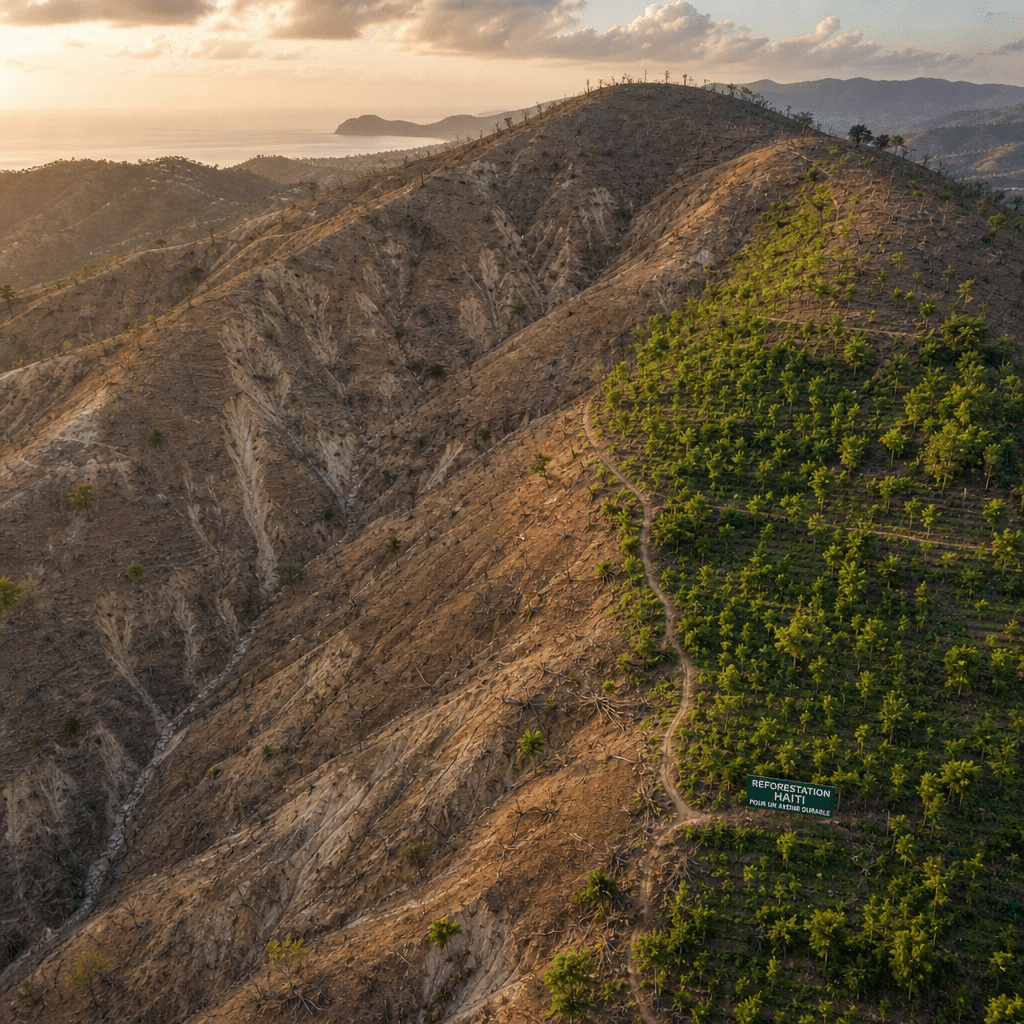
Haiti has lost more than 98% of its original forest cover, leaving its communities exposed to floods, landslides, and soil erosion that destroy crops, homes, and livelihoods with each passing rainy season. This is not a distant environmental statistic. It is the daily reality that Community2Community (C2C) addresses through its Environmental Stabilization Initiative, a program built on the principle that climate action in Haiti must be led by Haitian communities themselves, not imposed by outside organizations. The difference between sustainable change and aid dependency comes down to exactly that distinction.
| Key Insight | Explanation |
|---|---|
| Haiti has lost 98% of its forest cover | Deforestation is the root driver of flooding, soil erosion, and food insecurity in partner communities C2C serves. |
| Community-led reforestation outperforms top-down planting programs | Trees planted and maintained by local community members have significantly higher survival rates than those installed by external contractors. |
| Environmental stabilization directly supports food security | Restoring soil quality and watershed health allows subsistence farmers to produce more reliable yields without imported inputs. |
| C2C’s approach aligns with UN SDG 13 on Climate Action | The Environmental Stabilization Initiative targets climate resilience at the community level, meeting SDG 13 targets for adaptive capacity and disaster risk reduction. |
| Reducing aid dependency is a measurable climate outcome | When communities stabilize their environment, they require fewer emergency food and shelter interventions, reducing long-term foreign aid reliance. |
| Donor funding tied to environmental work has lasting multiplier effects | Every dollar invested in watershed restoration and tree cultivation protects infrastructure, agriculture, and health outcomes simultaneously. |
| External organizations often bypass community knowledge | Top-down environmental programs in Haiti have repeatedly failed because they ignored indigenous land management practices that C2C actively incorporates. |
Haiti sits at the center of the Caribbean hurricane belt and ranks among the most climate-vulnerable countries in the world. According to the Global Climate Risk Index, Haiti has been one of the ten most affected countries by extreme weather events over the past two decades. The country experiences this risk without the natural buffers, financial safety nets, or governmental infrastructure that would allow it to absorb repeated shocks.
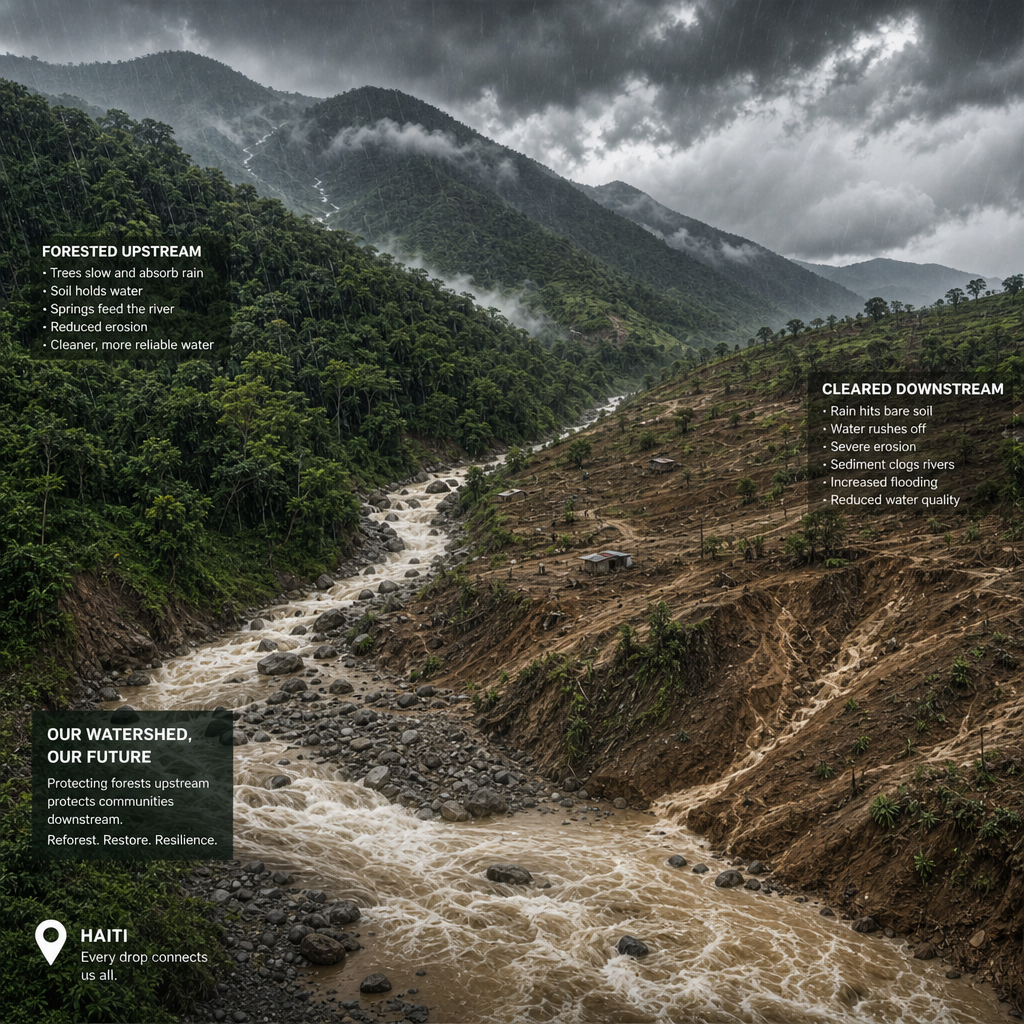
The deforestation problem did not happen overnight. Decades of charcoal production, agricultural clearing, and political instability stripped the land bare. Without tree cover, rainwater runs off hillsides instead of absorbing into the soil, triggering floods that destroy the same communities the rains are meant to sustain. This cycle is not inevitable. It is reversible with the right intervention model.
What makes Haiti’s situation especially urgent is the compounding effect. Soil erosion reduces agricultural productivity, which drives more charcoal production for income, which causes more deforestation. Breaking that cycle requires addressing the environmental and economic conditions simultaneously, which is exactly what C2C’s Environmental Stabilization Initiative is designed to do.
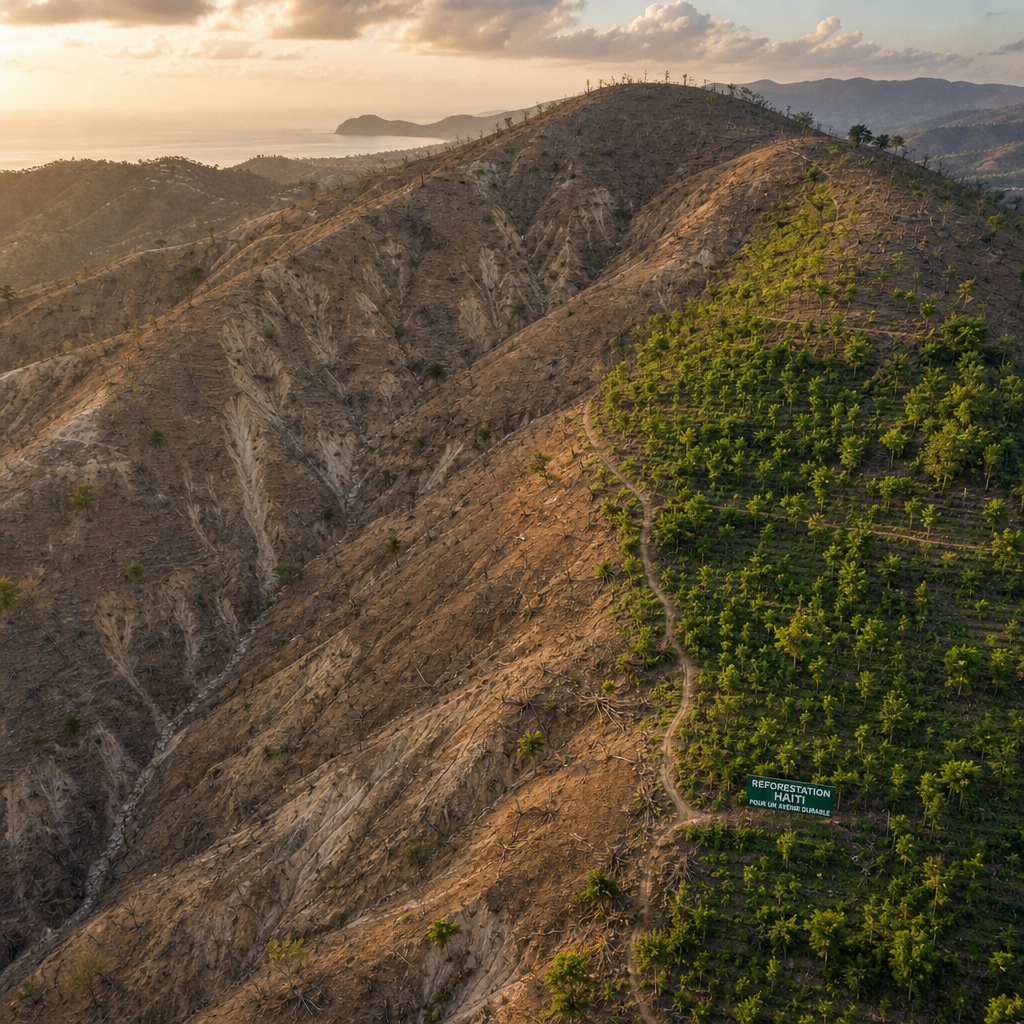
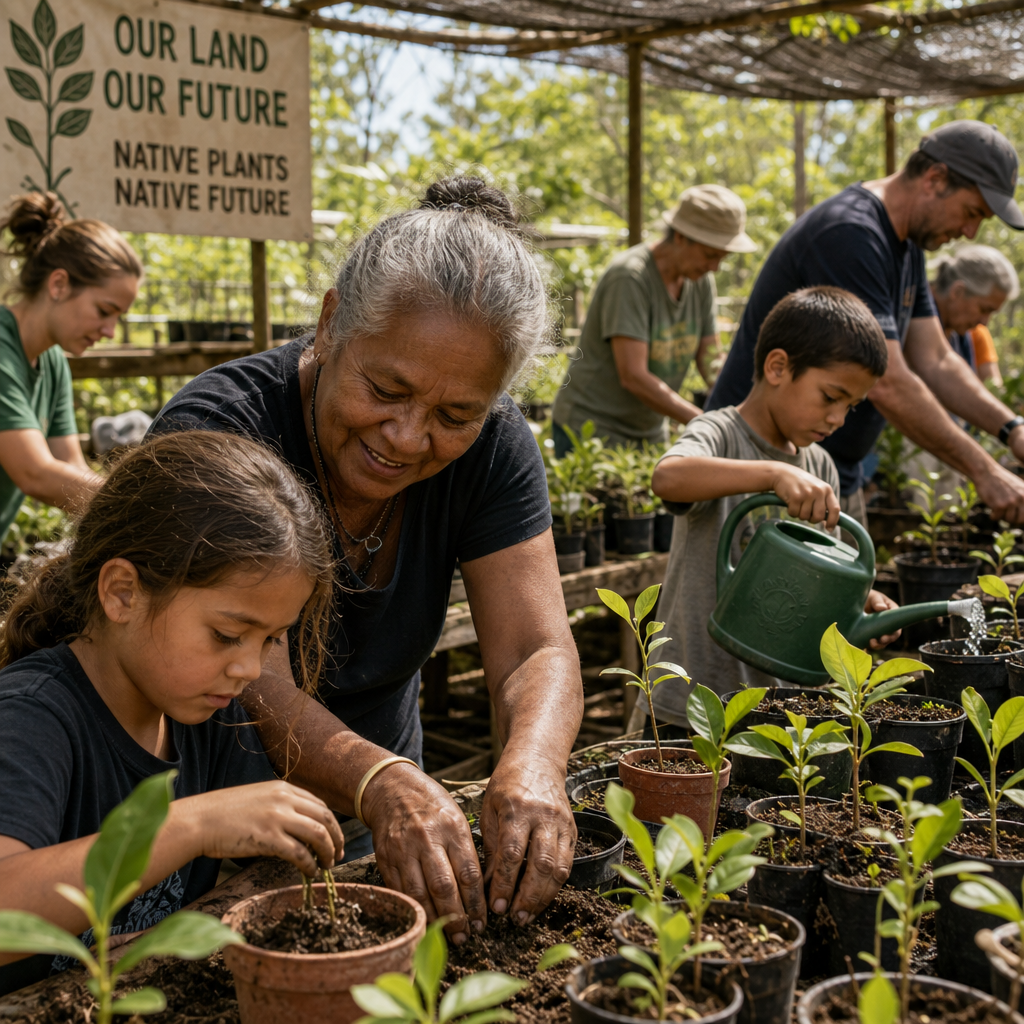
C2C’s Environmental Stabilization Initiative is a structured, community-implemented program that combines reforestation, soil conservation, and watershed management to protect Haitian communities from the direct consequences of climate instability. It is not a tree-planting campaign. It is a coordinated land restoration effort where community members plan, execute, and maintain the work themselves.
C2C treats tree planting as infrastructure investment, not charity. Native species are selected based on soil type, elevation, and community use. Fruit trees serve dual purposes: they stabilize slopes and provide food security. Hardwoods protect watersheds. Vetiver grass secures embankments against flash floods.
In practice, this means communities are not handed seedlings and left to manage on their own. C2C works through its Collaborative Framework to train local leaders in land management, establish community nurseries, and create accountability structures that sustain the work beyond any single planting season.
Protecting watersheds is one of the highest-leverage environmental actions available in Haiti. When a watershed degrades, every downstream community loses access to clean water for drinking, cooking, and irrigation. C2C partner communities map their water sources, identify vulnerable areas, and implement buffer planting and erosion control structures that protect the watershed from further degradation.
The data consistently shows that watershed protection reduces flood damage costs. Communities that have completed watershed stabilization projects report fewer post-hurricane rebuilding needs, which directly reduces emergency aid dependency. That is a measurable outcome donors can track.
Pro tip: When evaluating environmental programs in Haiti, ask for survival rates on planted trees at 18 and 36 months post-planting. This single metric distinguishes community-maintained programs from externally managed projects where trees are planted once and abandoned.
UN SDG 13 calls on nations and organizations to take urgent action to combat climate change and its impacts, with specific targets around strengthening resilience, integrating climate measures into national planning, and improving education and capacity on climate mitigation. C2C’s Environmental Stabilization Initiative maps directly onto these targets at the community level, where the actual resilience gap exists.
SDG 13.1 focuses on strengthening resilience and adaptive capacity to climate-related hazards. Every reforestation project C2C implements is a direct investment in that adaptive capacity. Communities that restore their tree cover reduce flood exposure, protect agricultural land, and maintain water supply through dry seasons, all of which are components of climate resilience the SDG framework identifies as critical.
“Climate change is not a future problem for Haiti. It is the present reality that determines whether a family eats this season or goes hungry. Addressing it requires building from the ground up, with the communities who have the most at stake.” – C2C Community Development Framework
SDG 13.3 targets improving education and human and institutional capacity on climate change mitigation. C2C’s training model, which builds local expertise in land management and environmental monitoring, fulfills this target in a way that foreign-staffed programs structurally cannot. The knowledge stays in the community after C2C’s facilitation role ends.
For international donors specifically, aligning grant portfolios with SDG 13 is increasingly a reporting requirement. Funding C2C’s Environmental Stabilization Initiative gives donors a credible, documented connection to SDG 13 outcomes with community-level evidence to support it.
The C2C Collaborative Framework is what separates the organization’s environmental work from conventional aid-model conservation projects. Rather than designing programs in Port-au-Prince or in a foreign donor office, C2C facilitates a process where communities identify their own environmental priorities, design solutions based on local knowledge, and implement those solutions with C2C’s technical and financial support.
Before any planting or construction begins, C2C partner communities conduct participatory land assessments. Community members identify which slopes are most vulnerable, which water sources are degrading fastest, and which areas, if stabilized, would have the greatest protective effect on homes and farms. This is not a consultant-written report. It is an assessment built from lived knowledge of the landscape.
A common mistake made by larger international NGOs is skipping this step entirely, arriving with a predetermined planting schedule that ignores land tenure issues, community use patterns, and the practical realities of who will maintain the work after the NGO staff departs. C2C does not make this mistake, and its program continuity data reflects that.
C2C invests in training community members as environmental stewards. These are not paid positions created by foreign funding that disappear when the grant ends. They are roles embedded in community governance structures, backed by community recognition and accountability. Environmental stewards monitor tree survival rates, manage community nurseries, coordinate erosion control maintenance, and train the next generation of community members in land management practices.
Pro tip: Donors evaluating organizational effectiveness should ask whether environmental training programs produce locally credentialed leaders or simply produce communities dependent on continued foreign technical assistance. The distinction matters enormously for long-term impact measurement.
Not all climate action programs in Haiti operate the same way. The approach an organization takes determines whether its environmental work produces lasting change or temporary improvements that reverse once funding cycles end. The comparison below reflects real operational differences between community-led and externally managed models.
| Approach | Community Ownership Level | Long-Term Sustainability |
|---|---|---|
| C2C Collaborative Framework (community-led reforestation and watershed management) | High. Communities design, implement, and maintain all environmental projects. Local leaders are trained and empowered. | High. Projects continue after C2C facilitation ends because ownership and knowledge remain in the community. |
| International NGO top-down model (external experts design and execute) | Low. Communities are recipients of projects rather than designers and implementers. Participation is often limited to labor. | Low to moderate. Maintenance typically depends on continued foreign funding and staff presence. |
| Government-led environmental programs (national reforestation campaigns) | Moderate. Some community involvement, but program design and resources are centrally controlled and subject to political change. | Variable. Dependent on political continuity, budget allocation, and institutional stability, all of which are fragile in Haiti’s current context. |
The data consistently shows that programs with high community ownership have greater tree survival rates, better maintenance of erosion control structures, and more sustained environmental improvement over five-year and ten-year periods. This is not a theoretical preference. It is the documented difference between programs that work and programs that produce photo opportunities for donor reports.
International donors and philanthropists who want their environmental funding to produce real, lasting outcomes in Haiti need to make a clear-eyed assessment of what they are investing in. Funding a tree-planting event is not the same as funding an environmental stabilization program. The outputs look similar in a quarterly report. The long-term results are completely different.
C2C’s Environmental Stabilization Initiative is built for donors who want measurable, sustained impact. The program tracks tree survival rates, watershed health indicators, flood damage reduction, and agricultural productivity changes in partner communities. These are outcomes tied directly to the restored dignity and reduced aid dependency that C2C’s mission prioritizes.
For community organizations and partner networks implementing sustainable development projects in Haiti, C2C’s model offers a replicable framework. The Collaborative Framework does not require C2C’s direct involvement to be effective. It requires local leaders who have been trained and supported to apply community-led assessment and implementation methods in their own contexts.
Environmental stabilization is not separate from poverty reduction, health outcomes, or education access. When communities stabilize their land, they protect the schools, clinics, and homes that every other development investment depends on. Donors who fund environmental work through C2C are not making a single-issue investment. They are protecting the entire development ecosystem of the communities C2C serves.
C2C’s Environmental Stabilization Initiative directly addresses deforestation, soil erosion, watershed degradation, and flash flood vulnerability. These are the primary environmental threats facing the rural Haitian communities where C2C works, and they are all interconnected. Restoring tree cover stabilizes soil, which protects watersheds, which reduces flood intensity and frequency.
Conventional reforestation programs typically involve external organizations selecting species, hiring laborers to plant trees, and departing once the planting phase is complete. Community-led programs like C2C’s involve communities in every phase: assessment, species selection, planting, maintenance, and monitoring. The critical difference is long-term tree survival and maintenance, which depends entirely on community investment in the outcome.
UN SDG 13 focuses on climate resilience, adaptive capacity, and climate change education. C2C’s Environmental Stabilization Initiative builds climate resilience through reforestation and watershed protection, strengthens adaptive capacity by training community environmental leaders, and integrates climate action into community-level planning processes. These are direct contributions to SDG 13 targets, documented at the community level with trackable outcomes.
The persistent failure of deforestation interventions in Haiti comes down to one structural problem: programs designed and managed by outsiders do not produce local ownership. When a funding cycle ends, there is no community institution to continue the work. C2C’s model is different because it builds the community institutions first, then supports them in executing environmental work rather than executing environmental work on their behalf.
Donors can expect documented outcomes including tree survival rates at 18 and 36 months, measurable reductions in flood damage in stabilized communities, improvements in watershed water availability, and increased agricultural productivity in areas where soil quality has been restored. C2C also tracks reduced emergency aid requirements in partner communities, which represents a direct measure of reduced foreign aid dependency.
Environmental degradation is a direct driver of poverty in rural Haiti. When soil erodes, crop yields fall. When watersheds degrade, clean water becomes scarce and expensive. When floods destroy infrastructure, communities lose economic assets they cannot replace without outside help. Stabilizing the environment protects the productive capacity of communities, which is the foundation of economic self-sufficiency that C2C’s broader development mission is built on.
If you have worked with community-based environmental programs in Haiti or have experience evaluating climate resilience investments in fragile states, share what you have observed in the field.
We would love your feedback and any insights you would share with others. What perspective would you add?