
Most donors who give to Haiti-focused nonprofits never ask hard questions before they write the check. That is a problem. Haiti has received billions of dollars in international aid over recent decades, and a significant portion of it has produced little lasting change at the community level. The root cause is not a lack of generosity. It is a lack of rigorous Haiti nonprofit evaluation before the money moves. This practical checklist gives international donors and philanthropists a clear, no-nonsense framework for separating organizations that create real self-sufficiency from those that simply perpetuate dependency while burning through funds.
The usual donor checklist, verify 501(c)(3) status, check a watchdog rating, confirm the overhead ratio, stops well short of what Haiti-focused giving actually requires. The Haiti context introduces layers of complexity that generic charity evaluation tools were never designed to handle.
Haiti has received roughly 13 billion dollars in relief and aid support from NGOs and various countries over the last decade alone. Yet community-level self-sufficiency remains out of reach for most Haitian families. That gap between inputs and outcomes is the central problem donors must probe before giving.
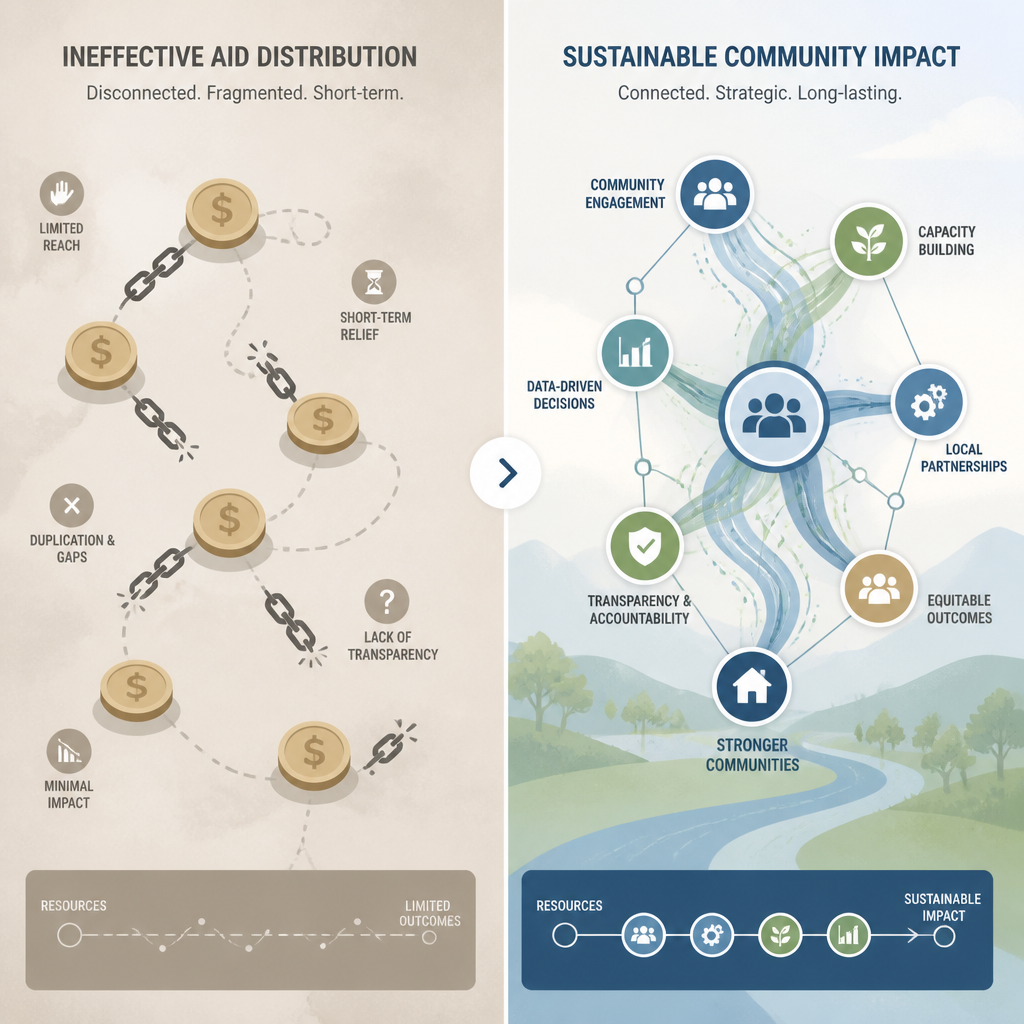
The question is not only whether a nonprofit is financially responsible. The more important question is whether its program model builds or erodes the capacity of Haitian communities to govern their own futures. An organization can score well on every standard watchdog metric and still be doing harm by flooding local systems with aid that crowds out Haitian-led initiatives.
The most important shift a donor can make is moving the evaluation question from “Is this nonprofit legitimate?” to “Does this nonprofit’s model actually lead to community self-sufficiency, or does it deepen dependency?”
| Key Insight | Explanation |
|---|---|
| Overhead ratio alone is misleading | A low overhead percentage does not confirm effectiveness. It only confirms that money is being spent on programs, not whether those programs work in Haiti’s specific context. |
| Community ownership is the real indicator | Strong Haiti nonprofits hand decision-making authority to partner communities, not to foreign staff or headquarters. Ask who sets the agenda for each project. |
| Form 990 is the baseline, not the finish line | Every qualifying U.S.-registered nonprofit must file a Form 990. It confirms legal compliance, but it tells you nothing about whether programs are working on the ground. |
| Exit strategy matters as much as entry | Organizations that cannot explain how a community will sustain its gains after the NGO leaves are not building self-sufficiency. They are building recurring need. |
| Local leadership is non-negotiable | Effective Haiti nonprofits employ and elevate Haitian leaders at the program design level, not just the implementation level. Check who actually runs country-level operations. |
| Watchdog ratings are a starting point only | Charity Navigator and similar platforms assess financial health and governance. They do not assess whether a development model respects Haitian community agency. |
| Impact reports should include failures | Any nonprofit that only reports successes is not being honest with donors. Credible impact reports document what did not work and what was changed as a result. |
Before evaluating anything else, confirm the nonprofit’s legal standing. For U.S.-based organizations working in Haiti, this means verifying 501(c)(3) tax-exempt status through the IRS Exempt Organizations Search tool. Any organization with tax-exempt status that takes in more than $50,000 per year is required to file a Form 990 with the IRS, and those filings are publicly accessible.
Do not accept the organization’s word for its legal status. Verify it directly on the IRS database. This takes less than two minutes and immediately filters out fraudulent or lapsed organizations, which do circulate during high-profile Haiti disasters when emotional giving spikes.
Platforms like Candid (formerly GuideStar) list more than 1.8 million IRS-recognized nonprofits and provide access to Form 990 filings, financial summaries, leadership information, and self-reported mission data. Charity Navigator provides a rating layer on top of that data, scoring organizations on financial health, accountability, and transparency. These tools are a useful starting point but treat them as a floor, not a ceiling, for your Haiti nonprofit evaluation.
A credible Haiti nonprofit will have a professional, current website with easy access to its financial statements, Form 990s, board membership list, and a clear statement of its program model. If that information is hard to find or outdated, that is itself a signal worth noting.
Pro tip: Search the organization’s name alongside terms like “audit report” or “annual report” to locate documents the nonprofit may not feature prominently on its homepage. A reluctance to publish audited financials is a red flag regardless of how compelling the mission sounds.

Financial health in a Haiti nonprofit context means more than keeping overhead low. It means understanding where the money comes from, where it goes, and whether the financial model is honest about what programs actually cost.
The overhead ratio, the percentage of expenses spent on administration and fundraising versus programs, is widely cited but frequently misused. A nonprofit that spends 95% of its budget on “programs” may simply be misclassifying administrative costs. Look instead at whether the organization publishes independently audited financial statements and whether those audits are conducted by a reputable external firm.
Check for multiple funding streams. Organizations that depend almost entirely on a single major donor or a single government grant are financially fragile and may compromise their program model to retain that funding. Diversified revenue, individual donors, foundations, earned revenue from community enterprises, is a sign of organizational maturity.
The most sophisticated financial question a donor can ask is not “What percentage goes to programs?” but rather “What does it cost this organization to achieve one measurable outcome?” That might be cost per latrine constructed, cost per child enrolled in a supported school, or cost per household reaching a defined self-sufficiency benchmark. Organizations that cannot answer this question have not thought seriously about efficiency.
Pro tip: Ask the organization directly for a cost-per-outcome figure from a recent project. A confident, specific answer, even if the number is higher than expected, indicates serious internal evaluation. A vague or deflecting answer indicates the opposite.
This is the criterion that separates the best nonprofits in Haiti from well-funded but ultimately counterproductive ones. The program model question is not about what the organization does. It is about who decides what gets done, and what happens when the organization is no longer present.
A program model that centers community ownership looks like this: Haitian community members identify their own priority needs, participate in designing the response, lead implementation, and take responsibility for long-term maintenance and governance. The nonprofit’s role is to provide resources, technical support, and connections, not to impose solutions designed elsewhere.
Ask the organization directly: Who sets the agenda for each community project? If the answer involves a headquarters team in a foreign country or a board of directors with no Haitian representation, the model is top-down regardless of how community-oriented the marketing language sounds. The C2C Collaborative Framework used by Community2Community, for example, is built around partner communities taking the lead on defining and implementing their own development priorities, with the organization serving as a collaborative resource rather than a directing authority.
Also ask about the organization’s relationship with local Haitian institutions: municipal government, community health councils, local schools, and market systems. Organizations that operate in parallel to these structures rather than strengthening them are substituting for local capacity rather than building it.
One of the clearest ways to assess a program model is to ask what happens when the organization leaves a community. If the honest answer is “the gains would likely disappear,” the model is not building self-sufficiency. It is building a recurring service relationship that perpetuates dependency, exactly the pattern that has made so much international aid in Haiti ineffective over decades.
Strong organizations can point to communities that have maintained and expanded project gains after NGO support tapered. That kind of documented sustainability is worth more than any watchdog rating.

Governance quality is one of the evaluation areas where watchdog databases provide real value. Look for a clear separation between the executive leadership and the board of directors. A board that is too close to the executive, or that consists primarily of personal connections to the founder, lacks the independence needed to provide genuine oversight.
Credible nonprofits publish a list of their current board members and key staff. Look at that list and ask whether it includes Haitian voices at the board level, not just at the program staff level. An organization claiming to serve and empower Haitian communities while maintaining an all-foreign leadership structure is not practicing what it preaches.
High executive turnover in a Haiti nonprofit is a meaningful warning sign. Development work in Haiti requires long-term relationship-building with communities and local institutions. Organizations that cycle through country directors every year or two are not building the trust and continuity that effective community partnerships require.
Ask how long the organization’s current country-level leadership has been in place, and whether there is a clear succession plan. Organizations built around a single charismatic founder with no identifiable second tier of leadership are institutionally fragile, and that fragility puts community partnerships at risk.
Rigorous impact measurement is non-negotiable for any organization claiming to do development work rather than relief work. The distinction matters: relief addresses immediate needs, while development builds the systems and capacities for communities to meet their own needs over time. Measuring development outcomes is harder, but the absence of measurement effort is a serious problem.
A credible nonprofit’s impact report will include both successes and failures, alongside a clear explanation of what changed as a result of what did not work. Reports that present only positive outcomes are not honest assessments. They are marketing materials, and donors who rely on them exclusively are making decisions without real information.
The most credible program evaluations include input from program participants, meaning Haitian community members who are directly affected by the work. An organization that measures its own success without systematically collecting community feedback is missing the most important data point. Look for evidence that community satisfaction and self-reported outcomes are part of the evaluation process.
Third-party verification, whether through independent audits, external program evaluations, or studies published in credible forums, adds a layer of credibility that self-reported data cannot provide. Ask whether the organization has ever commissioned an independent program evaluation, and request access to that report.
Community2Community’s approach to impact documentation, including its work toward UN Sustainable Development Goals covering poverty elimination, health, education, and sustainable infrastructure, reflects the kind of outcome-oriented framework that donors should look for. Tying program results to internationally recognized benchmarks provides a common standard against which progress can be measured objectively.
| Evaluation Approach | What It Measures | What It Misses |
|---|---|---|
| Charity Watchdog Rating (e.g., Charity Navigator) | Financial health, governance structure, transparency, IRS compliance. Quickly identifies fraudulent or fiscally irresponsible organizations. | Does not assess program effectiveness, community ownership, cultural appropriateness, or whether the development model reduces or deepens dependency in Haiti. |
| Form 990 Analysis | Revenue sources, expense breakdown, executive compensation, program descriptions, and organizational assets. Essential baseline for all U.S.-registered nonprofits. | Financial snapshots can be misleading without context. Does not reveal on-the-ground program quality or community reception of the work. |
| Direct Program Model Assessment | Who makes decisions, how communities participate, what happens after the NGO leaves, whether local leadership is genuinely empowered, and whether outcomes are independently verified. | Requires more time and direct engagement with the organization. Not easily automated. But this is the only approach that directly evaluates whether the organization is building or undermining Haitian community self-sufficiency. |
The most thorough donors use all three approaches in sequence: start with watchdog ratings to eliminate obvious problems, review the Form 990 for financial patterns, then go deep on the program model to assess whether the organization’s work aligns with genuine community empowerment. Skipping the third step is where most donors make their most consequential mistakes.
Some warning signs are clear enough that they should end the evaluation process immediately, regardless of how compelling the organization’s story appears.
Organizations that describe their work in purely emotional terms, “restoring hope,” “transforming lives,” without any specific program descriptions, measurable outcomes, or defined geographic focus, are not ready to be trusted with philanthropic dollars. Impactful development work is specific. It involves defined communities, defined interventions, and defined metrics. If an organization cannot be specific about what it does and how it measures results, the money will not be well spent.
An organization working in Haiti that has no Haitian representation at its board or executive level is not practicing community-led development. It is practicing charity at best and paternalism at worst. Haitian communities are not passive recipients of foreign expertise. They are capable and determined actors in their own development. Any organization that does not structurally reflect that understanding in its leadership is operating from an outdated and counterproductive model.
A credible nonprofit welcomes hard questions from donors. If an organization is evasive about its financials, refuses to share its program evaluation methodology, or cannot explain its exit strategy, those are serious red flags. The organizations worth supporting have nothing to hide and everything to demonstrate. Treat donor inquiries as a quality signal: organizations that respond quickly, specifically, and openly are telling you something important about how they operate.
Pro tip: Email the organization directly with three specific questions: What is your cost per measurable outcome in your most recent completed project? Who holds final decision-making authority in your partner communities? And can you share an independent program evaluation from the last three years? The quality and speed of the response will tell you a great deal about organizational culture and accountability before a single dollar changes hands.
The most important criterion is the program model: specifically, whether the organization genuinely transfers decision-making authority and long-term sustainability to Haitian communities. Financial compliance and watchdog ratings matter, but they do not tell you whether the work actually builds community self-sufficiency. That requires a direct assessment of how the organization designs, implements, and exits its programs.
Form 990s for U.S.-registered nonprofits are publicly available through Candid (formerly GuideStar) and through ProPublica’s Nonprofit Explorer. You can search by organization name or EIN. Any qualifying organization that takes in more than $50,000 per year is required to file one, and the document covers revenue, expenses, executive compensation, and program descriptions in significant detail.
Not necessarily. An excessively low overhead ratio can actually indicate that a nonprofit is misclassifying costs or underinvesting in the staff training, monitoring systems, and evaluation capacity needed to do effective work. A moderate overhead ratio paired with strong, independently verified program results is far preferable to a suspiciously low overhead ratio with no evidence that programs are working. Focus on outcomes, not just ratios.
In practice, community-led development means that Haitian community members identify priority needs, co-design solutions with the organization, lead implementation through local structures, and take ownership of ongoing maintenance and governance after external support ends. The nonprofit provides resources, technical assistance, and connections. It does not dictate project scope, timeline, or methods. Organizations like Community2Community structure their work through a collaborative framework precisely to ensure that community voice and ownership are built into the design, not added as an afterthought.
A credible impact report includes both successes and documented failures, along with an explanation of what changed as a result of what did not work. It reports specific, measurable outcomes tied to defined communities and projects, not just aggregate numbers or feel-good stories. It includes input from program participants, and ideally references or is accompanied by an independent third-party evaluation. A report that reads like a fundraising brochure, showcasing only positive outcomes with no acknowledgment of challenges, should be treated skeptically.
Size alone is not a reliable indicator of effectiveness. The relevant question is whether the organization’s model centers Haitian community agency and builds long-term self-sufficiency. Some smaller organizations with deep community roots and participatory models produce far more durable outcomes than larger organizations operating top-down programs at scale. Apply the same evaluation criteria regardless of size, and weight the program model assessment heavily in your final decision.
The C2C Collaborative Framework is the development model used by Community2Community (C2C) in Haiti. It structures the relationship between C2C and its partner communities so that communities lead their own development priorities with C2C serving as a resource and partner. The framework is designed to reduce reliance on foreign aid by building community-level capacity, governance, and self-sufficiency over time. For donors evaluating where to give, it represents an example of a structured, community-ownership-centered model that donors can ask other organizations to articulate in comparable terms.
Have you applied any of these criteria when evaluating a Haiti nonprofit, and what did you find? We would welcome your experience in the comments below.