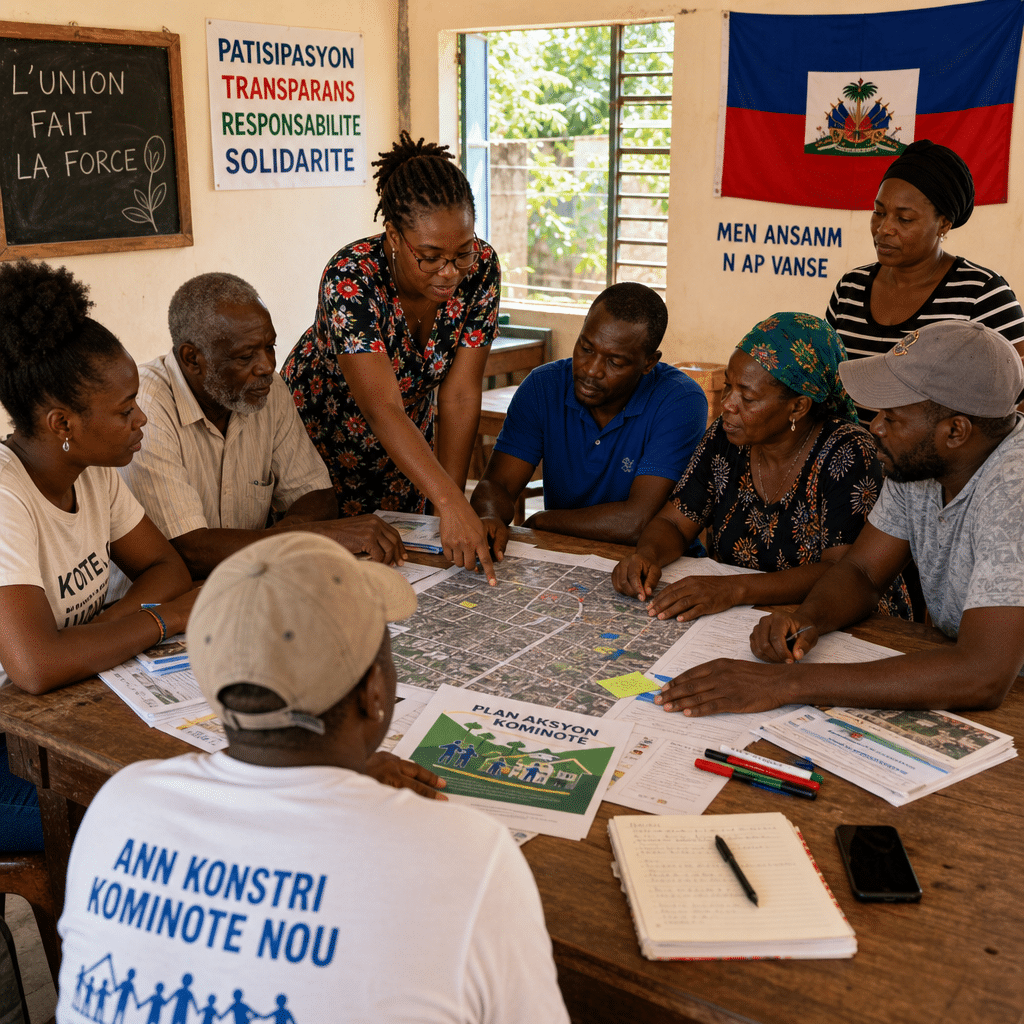
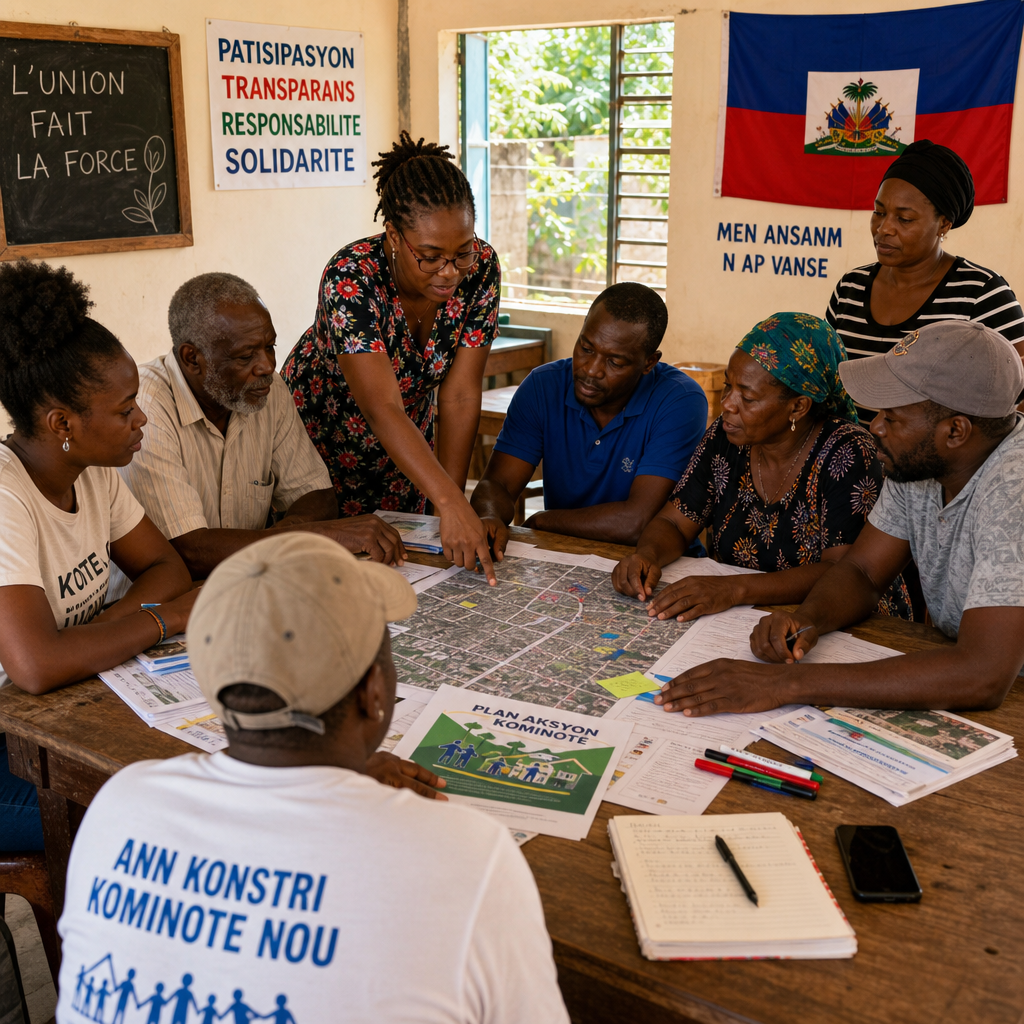
Most Haiti poverty relief efforts are built on a flawed premise: that outside help fixes broken communities. The data consistently shows the opposite. Communities that receive aid without agency become more dependent, not less. Dignity-based development rejects that model entirely. It starts from the position that Haitian families are not problems to be solved but partners in building their own future. Understanding what that actually looks like in practice, not just in mission statements, is what separates organizations that create lasting change from those that generate impressive reports and little else.
| Key Insight | Explanation |
|---|---|
| Dignity-based development centers community agency | Families and local leaders define priorities, not outside organizations. This shifts power and builds long-term ownership. |
| Aid dependency is a documented outcome of poor design | Organizations that bypass local institutions consistently produce communities that cannot sustain programs after funding ends. |
| Haiti has the infrastructure for self-sufficiency | Haitian communities have social capital, local knowledge, and leadership capacity that external programs routinely underestimate. |
| Donor accountability must flow toward communities, not headquarters | When organizations report success to donors rather than to partner communities, incentives become misaligned from day one. |
| Sustainable development in Haiti requires long time horizons | Meaningful change in health, education, and infrastructure takes 10 to 20 years. Short funding cycles undermine real progress. |
| Poverty is not the absence of resources alone | It is also the absence of voice, choice, and recognition. Development that ignores dignity reproduces poverty even with funding. |
| Community-led models outperform top-down aid in retention | Programs co-designed with communities show significantly higher rates of continued use and adaptation after the project period ends. |
The phrase gets used loosely, so it is worth being precise. Dignity-based development is not about making aid feel nicer or adding community consultation sessions to an externally designed program. It is a structural shift in who holds decision-making power throughout the entire development process, from problem identification through implementation to evaluation.
In practice, this means a Haitian community determines whether the priority is a water system, a school, a health clinic, or agricultural infrastructure. It means local leaders manage resources and are accountable to their neighbors first. It means an outside organization like Community2Community functions as a resource and technical partner, not a director.
This is not idealism. The World Bank’s own research on community-driven development programs shows that projects with genuine local governance produce better infrastructure quality, higher usage rates, and stronger maintenance outcomes than externally managed equivalents. Dignity is not just a value. It is a performance variable.
Pro tip: When evaluating any Haiti development organization, ask one question: who has the authority to stop a project? If the answer is only the outside funder or NGO headquarters, the program is not community-led regardless of what the brochure says.
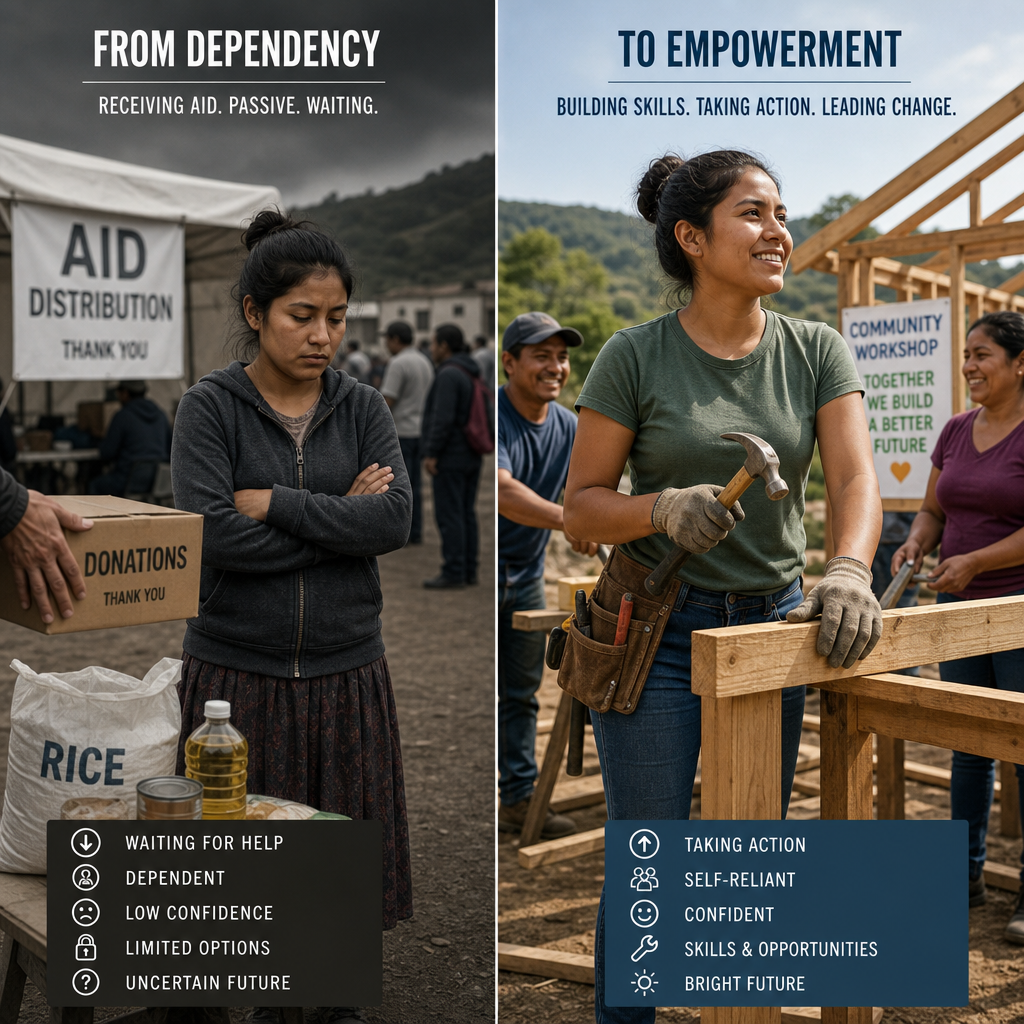
Haiti has received tens of billions of dollars in foreign aid over the past several decades. By almost every measurable indicator, that investment has not produced self-sustaining communities. A common mistake is to attribute this failure to Haiti itself, to its politics, its geography, or its history. That framing is both inaccurate and damaging.
The more honest analysis is that the dominant model of Haiti poverty relief was designed to fail at sustainability. It was optimized for speed of disbursement, visibility to donors, and replicability across contexts, none of which align with what actually builds community capacity.
Organizations that fly in experts, build something, and leave create what development practitioners call parachute aid. The infrastructure may be real, but the knowledge, maintenance capacity, and ownership do not transfer. Within two to five years, the school roof leaks and no one knows how to fix it. The water pump breaks and there is no local mechanic trained or funded to repair it.
This is not a Haiti-specific failure. It is a design failure that Haiti experiences at disproportionate scale because it receives a disproportionate amount of this type of aid.
When an organization’s funding depends on donor reports rather than community outcomes, the incentive is to document activity rather than measure lasting impact. Number of meals distributed. Number of houses built. Number of children enrolled. These metrics are easy to count and easy to photograph. They tell donors almost nothing about whether development is actually happening.
Dignity-based development requires harder metrics: Does the community now manage this program independently? Has local income increased in ways that are not tied to aid distribution? Are community members making decisions that contradict what the outside partner recommended? That last one is actually a sign of health, not failure.
Community2Community’s approach is built around what they call the C2C Collaborative Framework, a model explicitly designed to address the structural failures described above. The framework positions C2C as a partner, not a provider. Partner communities in Haiti retain ownership of project goals, resource management, and program evolution.
This distinction matters because it changes what C2C is accountable for. The organization is not accountable for delivering a specific output to donors. It is accountable for building the conditions in which a Haitian community can deliver outcomes to itself. That is a fundamentally different job description.
C2C’s work directly engages with several UN Sustainable Development Goals including SDG 1 (no poverty), SDG 3 (good health), SDG 4 (quality education), and SDG 9 (sustainable infrastructure). The critical difference between C2C’s approach and organizations like World Vision or GlobalCommunities is the pathway through which those goals are pursued. C2C pursues SDG outcomes through community self-determination rather than through program delivery.
For donors who care about the SDGs, this matters practically. A community that achieves SDG targets through its own leadership is far more likely to maintain those gains after external funding ends than one that received the outcome as a service.
“The most powerful form of development is when a community no longer needs the organization that helped them start.” This principle, embedded in C2C’s model, reflects a standard that very few international development organizations are willing to hold themselves to, because it makes the organization’s own presence temporary by design.
Pro tip: Ask any development organization for examples of communities they have formally exited because the community no longer needed them. If they cannot name any, their sustainability claims deserve scrutiny.

Not all Haiti development organizations operate the same way. The differences between models are not cosmetic. They produce measurably different outcomes for communities and different experiences for donors who want their giving to matter.
| Approach | Who Drives Decisions | Sustainability Outcome |
|---|---|---|
| Traditional aid delivery (e.g., large NGO top-down programs) | External organization or donor determines program design and priorities | Low: communities depend on continued external funding and management to sustain services |
| Participatory development (e.g., consultation-based models) | External organization consults communities but retains decision authority | Moderate: some local buy-in but ownership is incomplete and outcomes are mixed after exit |
| Community-led development (C2C Collaborative Framework) | Partner community holds decision authority with C2C as technical and resource partner | High: communities build capacity, manage resources, and sustain programs independently over time |
The comparison above is not theoretical. The distinction between consultation and genuine community authority is the single most predictive variable in long-term program sustainability. Organizations that consult communities but retain veto power are practicing a softer form of the same paternalism that drives conventional aid dependency.
Donors are not passive actors in this system. The way international donors structure their giving has a direct effect on whether organizations can pursue dignity-based models at all. Short grant cycles of one to two years make it nearly impossible to pursue the decade-scale community capacity building that sustainable development Haiti actually requires.
Restricted funding that mandates specific program deliverables forces organizations to prioritize funder requirements over community-identified needs. That is not a minor inconvenience. It is a structural contradiction that undermines the entire premise of community-led development.
Effective donors in this space commit to multi-year unrestricted or lightly restricted funding. They evaluate organizations on community outcomes rather than activity counts. They ask hard questions about exit strategies and community ownership transitions rather than requesting photos of construction projects.
For philanthropists supporting Haiti specifically, the most impactful question to ask an organization is not how many people they served last year. It is how many communities they have successfully transitioned to full self-management. The answer reveals whether the organization is building toward its own irrelevance, which is the actual goal of sustainable development Haiti requires.
Donors who give through C2C are supporting a model where their contribution is explicitly designed to make future contributions less necessary, not more. That is a rare and meaningful distinction in the Haiti development sector.
Dignity is harder to measure than a building, but it is not unmeasurable. Organizations serious about dignity-based development track a specific set of indicators that traditional aid programs typically ignore.
The first category is decision-making authority. What percentage of project decisions are made by community members without external approval? This can be tracked formally through governance records and is a direct proxy for real community ownership rather than ceremonial participation.
The second category is financial self-sufficiency trajectory. Is the community’s dependence on external funding decreasing over time as a percentage of total program costs? If year five looks the same as year one in terms of funding ratios, the model is not working.
The third and most important category is harder to quantify but critical to track. Do community members describe themselves as the authors of their own development? Do they take credit for successes rather than attributing them to outside helpers? Do they adapt programs when conditions change without waiting for external permission or instruction?
These qualitative indicators reflect a shift in identity and self-perception that is, in many ways, the most durable outcome of dignity-based development. A community that has internalized its own competence will continue developing long after any specific program ends. According to the United Nations Development Programme’s frameworks on human development, this kind of expanded agency is the central mechanism through which poverty is actually reduced at a systemic level, not through the transfer of goods or services alone.
Dignity-based development is an approach that places decision-making authority with the communities being served rather than with outside organizations or donors. Traditional aid typically involves external actors identifying needs, designing programs, and delivering services to communities. Dignity-based development inverts this structure: the community identifies its own priorities, manages its own resources, and evaluates its own progress. The outside partner provides technical support and resources without controlling outcomes.
The dominant model of aid to Haiti has been optimized for donor visibility and program replicability rather than community ownership. When programs are designed externally and managed by outside organizations, communities do not develop the governance capacity, technical skills, or financial management experience needed to sustain programs independently. The result is that outcomes last only as long as external funding continues. This is a design problem, not a Haiti problem.
C2C’s C2C Collaborative Framework explicitly positions the organization as a partner to Haitian communities rather than a service provider. Where larger organizations typically design programs at headquarters and implement them through local staff, C2C works directly with partner communities that hold decision-making authority over project direction and resource management. C2C also measures success in terms of community self-sufficiency over time, not activity volume or beneficiary counts.
Sustainable development in Haiti requires long funding commitments of at least five to ten years, genuine transfer of decision authority to communities, investment in local governance and financial management capacity, and a willingness to measure outcomes rather than outputs. It also requires donor patience with a process that looks slower in the short term than conventional aid delivery but produces outcomes that last beyond the funding cycle.
Ask three specific questions. First, can the organization name communities that have fully transitioned to self-management without ongoing support? Second, what percentage of program decisions are made by community members versus organizational staff? Third, how does the organization measure and report failure? Organizations practicing genuine dignity-based development can answer all three directly. Those that cannot are likely practicing a consultation model while calling it something more.
Yes. Programs that embed community governance and ownership show higher rates of infrastructure maintenance, higher program participation over time, and better adaptation when external conditions change. The data consistently shows that communities with genuine ownership over their development programs sustain health, education, and economic outcomes at rates that externally managed programs do not match after the project period ends. The evidence base for this comes from both academic research and longitudinal evaluations by organizations including the World Bank and UNDP.
If you have worked with dignity-based development programs in Haiti or supported organizations using community-led models, share what you have seen work and what has fallen short in practice.