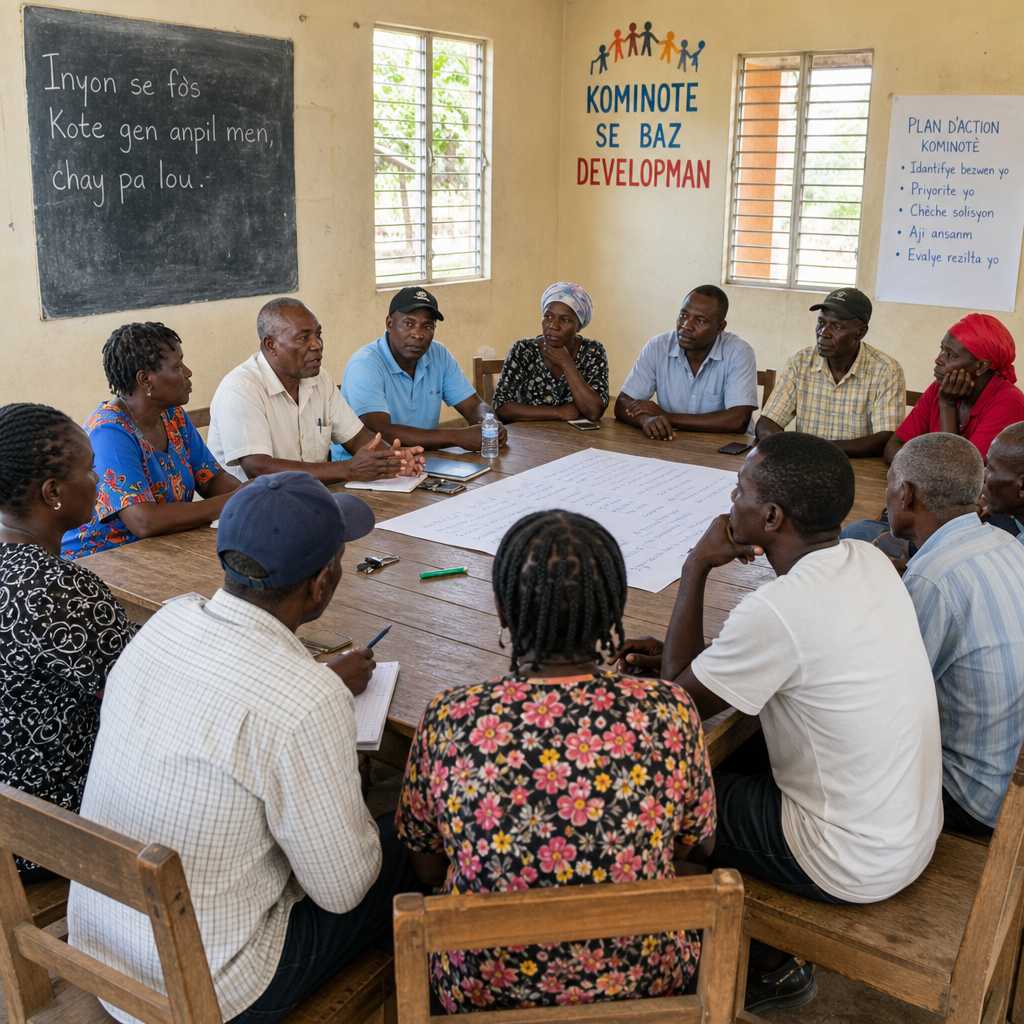
Most international donors arrive in Haiti with a mental model built from disaster headlines and charity telethons. That model is wrong, and Haitian communities are paying the price for it. Haiti community empowerment is not a feel-good phrase. It is a specific demand from community leaders who are tired of watching foreign organizations make decisions about their futures without them in the room. The question donors need to ask is not “What can we give?” but “What are communities actually asking us to do differently?” The answers are concrete, uncomfortable, and overdue.
| Key Insight | Explanation |
|---|---|
| Communities want decision-making power, not just resources | Haitian partner communities consistently report that being consulted after plans are made is not the same as being included in planning. Donors who fund pre-designed programs bypass local knowledge entirely. |
| Dignity is destroyed by transactional giving | When aid is delivered without community input or accountability to community standards, it signals that outside judgment matters more than local expertise. This actively erodes community confidence. |
| Short funding cycles undermine long-term infrastructure | A 12-month grant cannot build a water system, train local technicians, and establish a maintenance protocol. Communities asking for multi-year commitments are not being greedy. They are being realistic. |
| Relationship continuity matters as much as money | Communities that work within the C2C Collaborative Framework emphasize that consistent organizational relationships, not one-time donations, produce measurable and lasting progress. |
| Local leaders already have solutions | The most common frustration voiced by Haitian community leaders is that donors fund imported solutions while ignoring locally developed ones. Community-led development Haiti practitioners have strategies that work in their specific context. |
| Accountability should run both ways | Donors expect progress reports from communities, but communities rarely receive clear reporting on how funds were allocated or why program decisions were made. Mutual transparency is not optional if trust is the goal. |
| Foreign aid can create the very dependency it claims to solve | Programs that deliver goods without building local capacity to produce or maintain those goods guarantee a return visit. Communities are asking donors to fund capacity, not just commodity delivery. |
There is a pattern that repeats itself across Haiti and across the international development sector broadly. An organization identifies a need, raises money to address it, flies in staff or materials, delivers a program, and leaves. The community received something. But the community did not lead anything, decide anything, or build any internal capacity. That is not development. That is service delivery with a charitable label.
The concept of restore dignity Haiti is not abstract. In practice, dignity means that a community’s leaders are treated as the primary experts on their own situation. It means that program design reflects local knowledge, not just donor priorities. And it means that outcomes are measured against community-defined goals, not just donor-defined metrics.
A common mistake is assuming that because a community is poor, it lacks expertise. Rural Haitian communities often have sophisticated systems for water management, land use, and conflict resolution that predate any NGO’s arrival. When donors fund programs that ignore these systems, they are not just wasting resources. They are communicating that local knowledge has no value.


Research consistently shows that top-down aid programs produce weaker long-term outcomes than community-owned initiatives. The World Bank’s 2022 review of community-driven development programs across low-income countries found that projects designed and led by local communities had significantly higher rates of sustained use and maintenance after donor exit.
The C2C Collaborative Framework is built specifically around this evidence. Rather than arriving with a predetermined program, C2C works with Haitian partner communities to identify priorities and build the organizational capacity to pursue them independently. That distinction is not cosmetic. It changes who holds accountability and who develops expertise.
“The most important thing a donor can do is resist the urge to be the expert in the room. The community is the expert. Our job is to resource their vision, not replace it.” – C2C Collaborative Framework practitioner working in rural Haiti
Community-led development Haiti is a term that gets used loosely. Some organizations call a program community-led because they held one focus group before implementation. That is not what the term means, and communities know the difference immediately.
Genuine community-led development requires that communities set the agenda, not just approve one. It requires that local leaders have veto power over program design. It requires that community members are employed and trained as the primary implementers, not as volunteers supervised by foreign staff. And it requires that the exit strategy leaves the community stronger than it was before, not dependent on continued organizational presence.
Organizations like C2C operate as partners, not owners. That means they bring resources, technical knowledge, and cross-community learning into a relationship where the community remains the decision-maker. This is fundamentally different from how most large international NGOs operate, where the organization is the program owner and the community is the beneficiary.
The word “beneficiary” itself signals the problem. When communities are framed as passive recipients, the entire program design reflects that framing. Haitian community leaders asking for a different approach are asking donors to fund partners, not beneficiaries.
Pro tip: Before donating to any Haiti-focused organization, ask specifically who designs the programs and who has authority to change them mid-implementation. If the answer is the organization’s headquarters, that is a red flag for genuine community-led work.
Haiti receives roughly $1.3 billion in international aid annually, according to OECD Development Assistance Committee data. Despite decades of that level of investment, Haiti remains the poorest country in the Western Hemisphere by most standard indicators. That outcome is not a mystery if you understand how the aid is structured.
The majority of international aid in Haiti flows through foreign organizations that employ foreign staff, purchase foreign goods, and design programs using foreign frameworks. The money cycles through the aid system rather than building Haitian economic and institutional capacity. Communities have watched this pattern long enough to name it clearly: aid that creates dependency is not development, it is an industry.
When a donor gives to a program that ships in water purification tablets rather than training local producers to manufacture them, that donor is funding a supply chain that will require constant renewal. When a donor funds a school built by foreign contractors rather than training local construction workers, that donor is not building local construction capacity. The community gets a building. It does not get a construction sector.
C2C’s approach specifically targets this problem by working within communities to build the systems, skills, and institutions that allow communities to meet their own needs sustainably. The goal, stated plainly, is that communities should need C2C less over time, not more.

A common structural problem is that donors fund programs in 12-month cycles because that matches budget planning calendars. Community development does not operate on 12-month cycles. Building a functioning community health committee, training health workers, establishing referral protocols, and embedding those systems into community governance takes three to five years minimum.
Communities are not asking for more money in short cycles. They are asking for less money over longer cycles with genuine partnership commitments. That is a more cost-effective request than it sounds, because it eliminates the restart costs that short-cycle programs generate every year.
Pro tip: If you are a philanthropist considering Haiti-focused giving, prioritize multi-year unrestricted grants to organizations working inside the C2C Collaborative Framework model. Restricted, short-cycle grants force even good organizations to optimize for donor reporting rather than community outcomes.
Restoring dignity is not a slogan. It is a set of operational decisions that either happen or they do not. Donors have more influence over those decisions than they typically exercise, because most donors assume their job ends at the gift.
The first practical step is asking organizations you fund to show you evidence of how community priorities shaped program design. Not a testimonial. Not a photo of smiling community members. Actual documentation of community decision-making in the program record. If that documentation does not exist, the program was not community-led regardless of how it was marketed.
Most donors require organizations to report on activities, outputs, and sometimes outcomes. Very few donors require organizations to demonstrate that communities themselves evaluated the program and found it acceptable. That gap is where dignity gets lost.
The C2C model builds community evaluation into its process. Communities assess whether their own goals were met by their own measures. That is accountability that runs toward the community, not just toward the donor. Donors who require this kind of community evaluation in their grant requirements push the entire sector toward more honest programming.
One of the most direct ways donors restore dignity is by funding Haitian-led organizations and Haitian community leadership roles at compensation rates equivalent to what foreign staff receive. The data on pay disparities in international development is stark. Local staff routinely earn a fraction of what foreign counterparts earn for equivalent or greater responsibility. Communities notice this. It communicates values more clearly than any mission statement.
Not all organizations working in Haiti operate the same way. Understanding the structural differences between approaches helps donors make decisions that actually align with the outcomes they want.
| Approach Type | Who Holds Decision-Making Power | Long-Term Community Outcome |
|---|---|---|
| Traditional Foreign NGO Model (e.g., large international organizations) | Foreign headquarters staff and international program directors design programs based on donor requirements and organizational strategy | Communities receive services during the program period but typically do not develop the institutional capacity to sustain those services after the organization exits |
| Hybrid Partnership Model (e.g., organizations with local “chapters”) | Decisions are nominally shared but in practice follow organizational headquarters guidance, especially on budget allocation and program design | Some local capacity building occurs, but core decision-making remains outside the community, limiting ownership and long-term sustainability |
| Community-Led Collaborative Model (C2C Collaborative Framework) | Communities set priorities and hold decision-making authority over program design and implementation, with the partner organization providing resources and technical support | Communities build lasting institutional capacity, reduce external dependency over time, and develop the organizational infrastructure to pursue additional goals independently |
The evidence for community-driven development is not thin. The World Bank has evaluated community-driven development programs across dozens of low-income countries and consistently finds that community ownership correlates with better maintenance, higher usage rates, and more equitable distribution of benefits than top-down programs.
A 2019 meta-analysis published by the International Initiative for Impact Evaluation reviewed 51 rigorous studies of community-driven development programs. The analysis found that programs with genuine community control over resource allocation produced measurably better outcomes on health, education, and infrastructure maintenance than programs where communities were consulted but not empowered to decide.
The same data set makes clear what failure looks like. Programs that deliver infrastructure without community maintenance training have a median asset lifespan of under three years in low-resource settings. Programs that train community members as primary maintainers see assets functioning past ten years in the majority of evaluated cases. The difference is not the quality of the asset. It is whether the community owns the responsibility for it.
Haiti has hundreds of broken water pumps, unused health clinics, and abandoned agricultural projects that were funded by well-intentioned donors. Those failures are not evidence that development does not work in Haiti. They are evidence that top-down development does not work anywhere.
The UN Sustainable Development Goals explicitly call for “leaving no one behind” and prioritize local ownership of development processes. SDG 16 specifically targets inclusive and accountable institutions at all levels. Haiti community empowerment work that operates through the C2C Collaborative Framework is directly aligned with these international frameworks, which matters to institutional donors and philanthropic foundations that tie their giving to SDG alignment.
The organizations that perform best against SDG metrics in Haiti are consistently those that hand decision-making authority to communities rather than retaining it organizationally. This is not a coincidence. It is the mechanism through which SDG outcomes are actually produced at the local level.
In practice, Haiti community empowerment means that a community’s elected or selected leaders chair the meetings where program priorities are set, control the budget allocations within agreed parameters, and evaluate whether outcomes matched their own goals. It is visible in how organizations structure their decision-making processes, not just in how they describe their values. Organizations working within the C2C Collaborative Framework provide a concrete model of what this looks like operationally across health, education, and infrastructure programs.
Because dignity and results are not separate outcomes. Communities that experience programs as imposed on them rather than led by them have lower participation rates, lower maintenance commitment, and lower trust in future programs. The data on community-driven development is clear that process quality, meaning whether communities genuinely lead the work, directly predicts outcome quality. Restoring dignity is not an add-on to effective development. It is the mechanism through which effective development happens.
Ask for three specific pieces of documentation: community priority-setting records that predate program design, budget allocation decisions made by community members rather than organizational staff, and community-authored evaluations of program outcomes. If an organization cannot produce all three, its community-led claims are marketing language rather than operational reality. The distinction matters because it predicts whether your funding will produce lasting impact or temporary service delivery.
Direct giving bypasses the organizational overhead problem but creates a different challenge: communities need organizational capacity and cross-community learning that individual donors cannot provide. The strongest outcomes come from funding organizations that operate as genuine partners within a collaborative framework, not as program owners. The C2C model is specifically designed to build community capacity while maintaining the accountability and learning infrastructure that individual direct gifts cannot provide.
Funding activities rather than capacity. When donors fund a specific deliverable like building a school or distributing food, they get that deliverable once. When donors fund the organizational and leadership capacity of a community to identify, plan, and execute its own priorities, they get compounding returns that outlast any single program. The most impactful Haiti donors have shifted from project-based to capacity-based giving and report dramatically better long-term outcomes for the same or lower investment.
The core structural difference is where authority sits. In large international NGO models, authority over program design, budget, and evaluation sits at organizational headquarters, with communities as recipients of that process. In the C2C Collaborative Framework, authority sits with the community, with C2C serving as a resource and learning partner rather than a program owner. This is not a minor operational variation. It produces fundamentally different community outcomes because it builds community agency rather than community dependence.
If you have worked directly with Haitian communities or have experience as a donor in community-led development programs, share what shifted your perspective in the comments below.
We would love your feedback and any insights you would share with others. What perspective would you add?