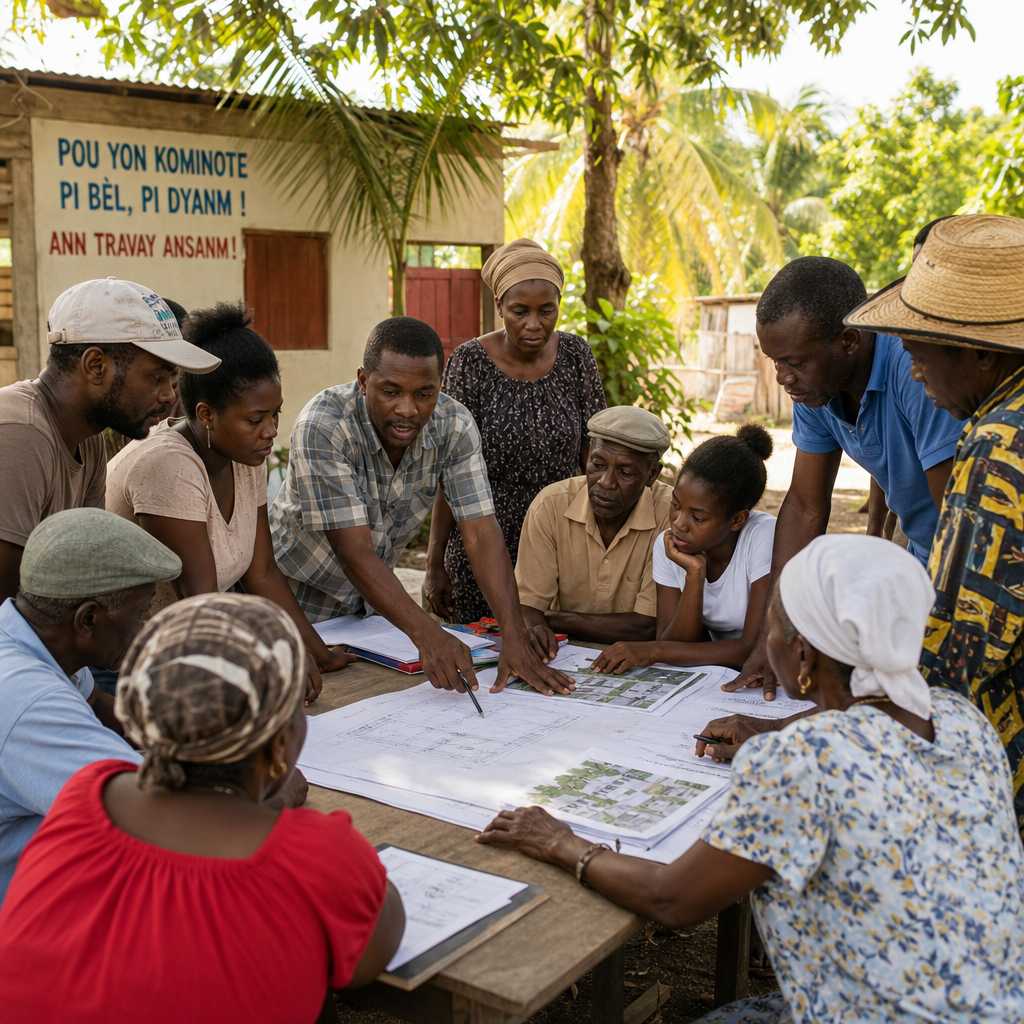
Haiti has received billions in foreign aid over the past two decades, yet poverty rates remain among the highest in the Western Hemisphere. The problem is not generosity. The problem is the model. Emergency relief, while necessary after disasters, has too often displaced the longer-term work of building systems, skills, and institutions that communities can own and sustain themselves. Sustainable development in Haiti requires a fundamental shift from donor-driven charity cycles to community-led frameworks that restore agency, build local capacity, and measure success in decades, not donation cycles.
| Key Insight | Explanation |
|---|---|
| Relief is not development | Emergency aid addresses immediate survival but does not build the infrastructure, governance, or skills needed for lasting change in Haitian communities. |
| Community ownership drives outcomes | Projects designed and managed by Haitian communities show significantly higher sustainability rates than those designed externally and handed over after implementation. |
| Foreign aid dependency is measurable and harmful | The World Bank estimates that Haiti receives aid equivalent to roughly 20% of its GDP, yet this inflow has not produced proportional reductions in poverty, pointing to structural dependency rather than empowerment. |
| The C2C Collaborative Framework centers local leadership | Community2Community’s model requires partner communities to identify their own priorities, lead implementation, and take ownership of outcomes rather than receiving pre-designed programs. |
| Education and health gains require systemic investment | One-time school builds or medical missions produce short-term impact. Sustained gains in literacy and child health come from training local educators and health workers embedded in communities. |
| Donor funding choices shape incentives on the ground | Funders who require community co-investment and multi-year accountability from partner organizations incentivize more rigorous, locally-owned development work. |
| Dignity restoration is an explicit development goal | Effective Haiti development organizations treat the restoration of community dignity and self-determination as a measurable outcome, not an afterthought to infrastructure metrics. |
The 2010 earthquake generated an estimated $13.5 billion in pledged international assistance. More than a decade later, many of the communities that received that aid remain deeply impoverished, with fragile infrastructure and limited local capacity. The data consistently shows that volume of funding is not the determining variable in development outcomes. How aid is structured, who controls it, and whether it builds or replaces local systems is what actually matters.
A common mistake is treating relief and development as points on the same continuum when they are actually different disciplines with different goals. Relief is designed to stabilize acute suffering. Development is designed to create conditions where communities no longer need relief. Conflating the two, or allowing relief organizations to define the development agenda, keeps communities in permanent recipient status.
Haiti has been described by some development economists as a “republic of NGOs.” Estimates from the early 2010s placed the number of active NGOs in Haiti at over 10,000, making it one of the most NGO-dense countries per capita on Earth. That density did not translate into proportional improvements in health, education, or income. In practice, many organizations brought their own operational frameworks, hired from outside local communities, and left behind programs that collapsed once external funding dried up.
Structural dependency develops when communities learn to wait for external decisions rather than making their own. This is not a cultural failing. It is a predictable response to a system that consistently bypasses local leadership and expertise.
Pro tip: When evaluating any Haiti-focused development organization, ask what percentage of project leadership roles are held by Haitian community members, not expatriate staff or visiting consultants. That ratio is one of the clearest proxies for whether the model is building or replacing local capacity.


Community-led development is not a branding statement. It has specific operational characteristics that distinguish it from conventional top-down aid models. In practice, it means that communities identify their own priorities rather than inheriting a program agenda, that local leaders hold decision-making authority over resource allocation, and that external organizations serve as technical or financial partners rather than program managers.
This model is harder to execute than conventional aid delivery. It requires development organizations to invest in relationship-building, trust, and local capacity before any visible project work begins. It also produces different success metrics. Community-led projects often start slower and look less impressive in short-term donor reports, but they are dramatically more likely to remain functional five and ten years after external funding ends.
Many organizations claim community participation while retaining all real decision-making power at headquarters or in the hands of a foreign program director. Participation means communities were consulted. Ownership means communities control what happens. The distinction is critical, and donors who cannot identify which one their funded organization is actually practicing are funding the wrong thing.
Organizations like Community2Community are explicit that community ownership is not a phase to be reached after external management proves the concept. It is the starting condition. Haitian partner communities work within the C2C Collaborative Framework to define their own development goals, which may or may not align with what donors in North America or Europe would have chosen for them.
“Development is not something that happens to communities. It is something communities do for themselves, with the right support at the right time.” – Principles of Community-Driven Development, World Bank Development Research Group
Community2Community’s Collaborative Framework operationalizes community-led development through a structured partnership model that explicitly addresses the UN Sustainable Development Goals, including poverty elimination, health equity, quality education, and sustainable infrastructure. The framework is not a one-size-fits-all program. It is a process that different partner communities adapt to their specific geographic, economic, and social contexts.
In practice, this means C2C does not arrive in a Haitian community with a pre-built school design or a standardized health curriculum. It arrives with a collaborative methodology that helps communities identify where they are, where they want to be, and what combination of local assets and external resources can move them there. The difference sounds subtle. The outcomes are substantial.
Most development organizations measure success by outputs: schools built, meals distributed, children vaccinated. C2C measures success partly by whether communities need less external support over time. Reducing reliance on foreign aid is written into the mission, not treated as a distant aspiration. This creates a very different set of incentives for program design.
An organization that profits from dependency will not design programs that build community self-sufficiency. An organization genuinely committed to reducing foreign aid reliance will design every intervention with an exit strategy built in, and will evaluate each program by asking whether it transfers capacity to local people or retains it in external hands.
Pro tip: Ask any Haiti development organization you are considering funding to show you data on what happens to their programs three years after they complete an intervention. Organizations committed to sustainability can answer that question. Organizations focused primarily on short-term outputs often cannot.

Not all Haiti development models produce the same outcomes, and donors deserve a clear framework for distinguishing between them. The following comparison covers three approaches that represent the dominant strategies active in Haiti today.
| Approach | Who Controls the Agenda | Sustainability Track Record |
|---|---|---|
| Relief-Centered Aid (e.g., large INGO emergency response programs) | External organization or donor government defines priorities based on crisis response needs, not community development priorities | Low. Programs tied to funding cycles often collapse within 1-2 years of funding withdrawal. Infrastructure is built but not maintained because local ownership was not established |
| Conventional NGO Development (e.g., programs from organizations like World Vision Haiti operations) | External organization designs programs in consultation with communities, but retains operational and financial control throughout | Mixed. Larger organizations bring resources and scale, but external control limits long-term community ownership. Outcomes vary significantly by program type and local context |
| Community-Led Collaborative Development (e.g., C2C Collaborative Framework at c2chaiti.org) | Haitian partner communities identify priorities and lead implementation. External organization provides methodology, technical support, and funding partnerships | High for programs designed from the start with community ownership. Slower to initiate but significantly more likely to sustain after external funding ends, with local leaders maintaining momentum |
The comparison above is not an argument that large international organizations have no role in Haiti. It is an argument that the model an organization uses matters more than its size, reputation, or donor base. Donors should apply these criteria to any organization they are evaluating, including Community2Community.
Haiti community empowerment is a phrase that appears in nearly every development organization’s materials. In practice, it means different things across the sector, which makes it both useful and susceptible to misuse. The following breakdown reflects what the evidence from Haiti-specific development research actually shows.
Training local educators rather than importing teachers produces lasting literacy gains because the knowledge and relationships stay in the community. Building and supporting community health worker networks reduces child mortality more sustainably than periodic medical missions because it creates year-round care capacity. Supporting community governance structures, including local planning committees with real decision-making authority over development projects, correlates with higher infrastructure maintenance rates and better long-term outcomes across sectors.
The data consistently shows that programs which invest in human capacity within communities outperform programs that deliver physical outputs managed by external actors. A clinic with no trained local staff is a building. A community with trained health workers is a functioning health system.
Short-term mission trips that complete projects without transferring skills or maintenance knowledge. Water system installations without trained local repair technicians. School construction without teacher training and curriculum support. These interventions are well-intentioned and often highly visible in donor reports, but they rarely produce the long-term gains they promise. A common mistake is confusing donor satisfaction, which is often produced by visible, tangible outputs, with community benefit, which requires sustained local capacity.
Organizations doing this work well are transparent about this distinction. They are willing to show donors why a program that looks less impressive on paper, because it invested primarily in training and capacity building rather than construction, actually produced better long-term outcomes than a program that built visible infrastructure that later fell into disrepair.
International donors and philanthropists have more influence over the quality of development work in Haiti than many of them realize. Funding decisions shape organizational incentives, and organizational incentives shape program design. Donors who require accountability for long-term community outcomes, rather than short-term activity reports, push the entire sector toward better practice.
Look for organizations where Haitian community members hold visible leadership roles, including in program design and evaluation, not just in field execution. Look for multi-year accountability frameworks rather than single-project funding cycles. Look for organizations that can show you what happens to their programs after they leave, and that frame community self-sufficiency as a success metric rather than a program risk.
Community-led development in Haiti requires patient capital. Most meaningful capacity-building work takes three to five years to show the kind of systemic outcomes that justify the investment. Donors who require year-one results push organizations toward visible short-term outputs at the expense of lasting change. Giving yourself a longer evaluation horizon is one of the most impactful adjustments a thoughtful donor can make.
Programs that require communities to co-invest, through labor, local materials, or financial contribution, consistently outperform fully externally funded programs. Co-investment creates accountability and signals genuine community prioritization. If a community is not willing to contribute anything to a project, that is important information about whether the project reflects their actual priorities or someone else’s agenda.
Community2Community’s approach explicitly incorporates community co-investment as a design principle, not as a cost-saving measure. It is a mechanism for ensuring that programs address real community priorities and that communities have skin in the outcome from day one.
Emergency relief addresses acute survival needs following crises like earthquakes or hurricanes. Sustainable development builds the systems, institutions, and local capacity that allow communities to meet their own needs over time. The two require different organizational models, different funding structures, and different success metrics. Effective Haiti development organizations maintain a clear boundary between these two modes of work rather than treating them as interchangeable.
The primary reason is that most aid was designed and delivered using external frameworks that bypassed local leadership, replaced rather than built local systems, and measured success by inputs delivered rather than community outcomes achieved. High volumes of funding did not compensate for structural designs that created dependency rather than capacity. The World Bank and independent evaluations of Haiti aid post-2010 both document this pattern.
The C2C Collaborative Framework begins with community-identified priorities rather than pre-designed programs. Haitian partner communities hold decision-making authority over their development goals and implementation strategies. C2C provides methodology, technical support, and donor relationships, but the agenda and ownership belong to the community. This is structurally different from conventional models where external organizations design programs and then seek community participation in executing them.
Ask three questions: Who designed the program, the external organization or the community? Who holds decision-making authority over the budget and timeline? What evidence exists that similar programs have remained functional three to five years after external funding ended? Organizations with genuine community-led models can answer all three questions with specifics. Organizations using community-led language for fundraising purposes typically cannot.
The most directly relevant SDGs for Haiti include SDG 1 (No Poverty), SDG 3 (Good Health and Well-Being), SDG 4 (Quality Education), SDG 6 (Clean Water and Sanitation), and SDG 11 (Sustainable Communities). Organizations like C2C explicitly align their community development frameworks to these goals, which provides both a planning structure and a set of internationally recognized metrics for evaluating program impact.
Yes, in the short term. Building community ownership, establishing trust, training local leaders, and developing locally appropriate solutions takes more time upfront than deploying a pre-designed external program. But the data consistently shows that community-led programs sustain longer, produce more durable outcomes, and are significantly less likely to collapse when external funding ends. For donors with a genuine long-term impact orientation, this tradeoff is straightforward.
If you have worked with or funded Haiti development programs, we would like to hear what you have observed about what actually creates lasting change at the community level.